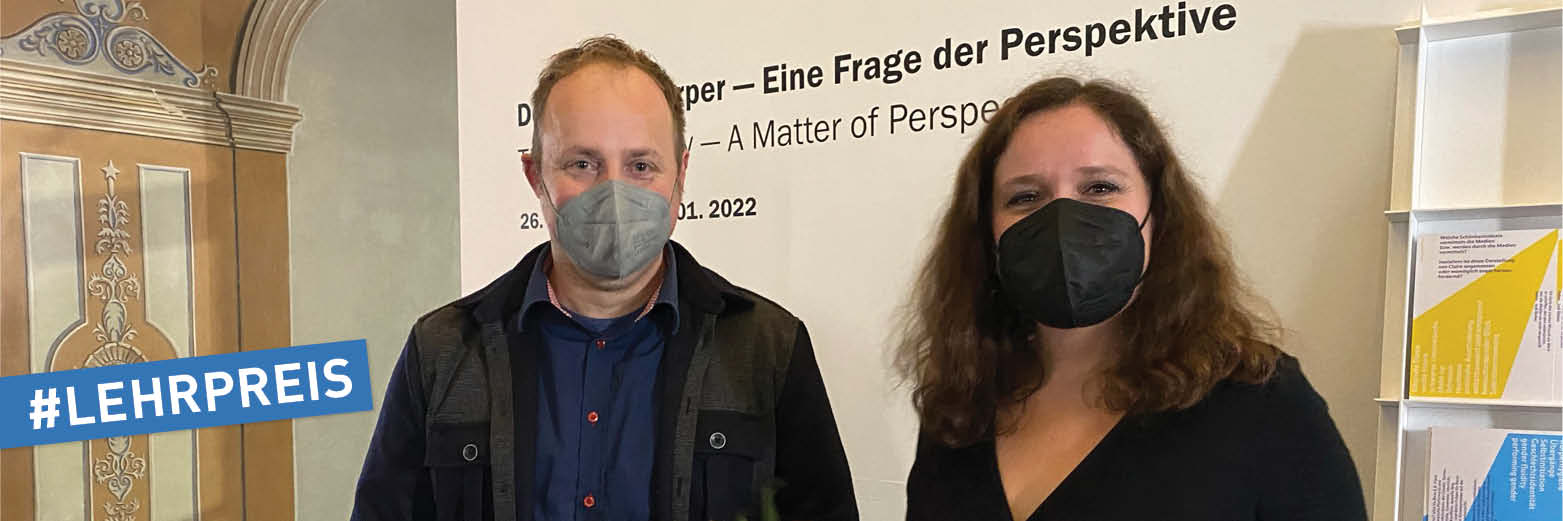
 The six-member jury has recognised the commitment and the concept, which has had a far-reaching impact across the entire region. ‘The Naked Body – A Question of Perspective’ is the title of the exhibition at the Museum Kurhaus Kleve, which can be visited until mid-January 2022. Students on the Bachelor’s degree programme in Gender and Diversity have organised the exhibition over the past year as young curators, working alongside their lecturer, Prof. Dr Eva Maria Hinterhuber. The project, which is funded by the state, explores nudity and the various perspectives on it. How the naked body is perceived, and whether a body is regarded as naked, depends largely on the historical, religious, social and cultural – as well as political – context. In the work produced as part of the ‘(Museum) Project’ module, the students explored questions such as: How can the boundaries of what is socially perceived as beautiful be expanded? How can nudity be depicted artistically in such a way that it expresses self-empowerment, strength or even tranquillity? How can artistic approaches overcome a colonially shaped, white perspective on the naked body?
The students focused on analysing gender relations in conjunction with other categories of social inequality (such as ethnic origin, religion or worldview, age, sexual orientation, etc.). The exploration of the body, sexuality and nudity plays an important role in Gender and Diversity Studies; equally, the nude body has been a familiar and significant subject in the visual arts across all eras and styles, and remains ubiquitous to this day. In this context, the artistic exploration of the nude body can both reflect and challenge social (power) relations.
The students were accompanied at the Museum Kurhaus Kleve by the artist, curator and art educator Gerd Borkelmann; the art historian, museum educator and art educator Alexandra Eerenstein; and the curator and research assistant at the Museum Kurhaus Kleve, Valentina Vlašić; whilst the university was represented by Professor Eva Maria Hinterhuber and, as the project’s initiator and student assistant, Crystal Hassell, a student of Gender and Diversity.
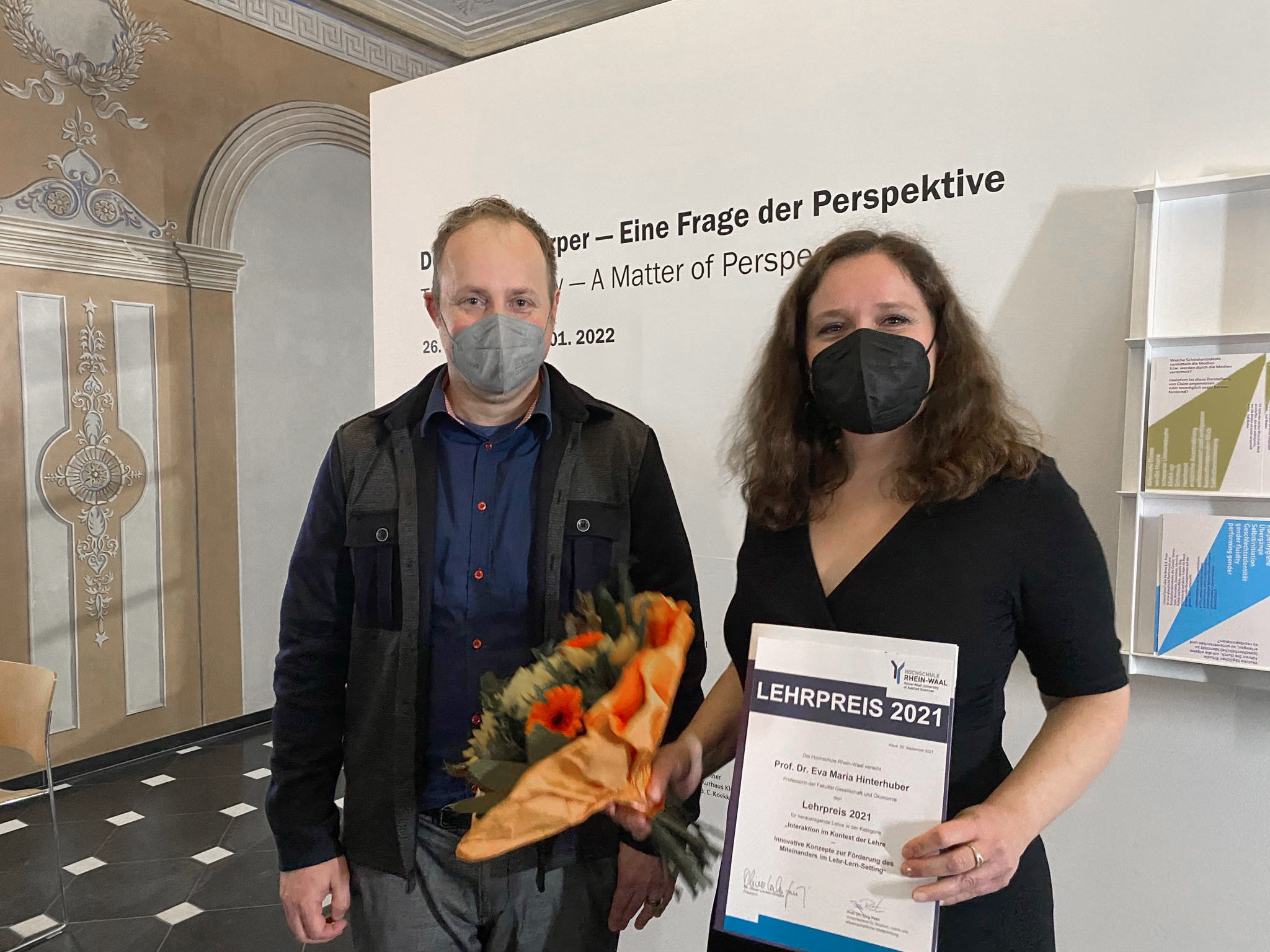
Prof. Dr Tatiana Zimenkova, Vice-President for International Affairs and Diversity, addressed those present with a welcome speech and emphasised that this project brought together art and academia, highlighting a special collaboration. As part of the opening ceremony, Prof. Dr Jörg Petri, Vice-President for Student Affairs, Teaching and Academic Continuing Education, presented this year’s Teaching Award to Prof. Dr Hinterhuber on behalf of the jury in recognition of her exceptional teaching approach. Vice-President Petri emphasised that teaching can now be experienced not only publicly but also aesthetically. Professor Hinterhuber has succeeded in making teaching – which normally takes place out of public view behind the walls of the university – visible. “This gives both students and the public a very good insight into how learning content is put into practice,” said Petri. Professor Hinterhuber expressed her delight at “working at a university that is open to new ideas.”
The exhibition was sponsored by the Ministry of Culture and Science of the State of North Rhine-Westphalia, the Friends of the Kurhaus Museum and Koekkoek-Haus Kleve e.V.
Background: Teaching Award at Rhein-Waal
University of Applied Sciences By presenting the Teaching Award, Rhein-Waal University of Applied Sciences demonstrates the high priority it places on the quality of teaching within the institution and recognises the commitment of its teaching staff. The Teaching Award is presented under a theme that changes annually and comes with a prize of 4,000 euros.
In 2021, as teaching continues to take place mainly online and academic culture is struggling to flourish, the Teaching Award will be presented under the theme ‘Interaction in the Context of Teaching – Innovative Concepts for Fostering Collaboration in the Teaching and Learning Setting’.
Nominations may be made for any member of the professorial staff, as well as all academic staff and lecturers in special posts, who taught at Rhein-Waal University of Applied Sciences during the summer semester of 2020, the 2020/2021 winter semester and the 2021 summer semester at Rhein-Waal University of Applied Sciences, and who, during this period, promoted interaction between students and/or between learners and teachers within their teaching and incorporated this innovatively into their teaching approach. A six-member jury decides on the nominations submitted. In 2021, the Teaching Award was presented for the eleventh time.
About the recipient: Prof. Dr Eva Maria Hinterhuber
Born in Innsbruck, she obtained her PhD in comparative political sociology from the European University Viadrina (Frankfurt/Oder) and previously studied political science, Slavic Studies and Law at the Free University of Berlin, St Petersburg State University (Russia) and the Leopold Franzens University of Innsbruck (Austria). She worked as a research assistant at the Open University of Hagen and at the Maecenata Institute in Berlin, and was a lecturer at various universities, higher education institutions and postgraduate institutes in Germany and abroad. In addition, she has worked for various non-governmental organisations in the field of women’s and peace work. Eva Maria Hinterhuber is a board member of the Working Group for Peace and Conflict Research and co-editor of ‘Femina Politica. Journal of Feminist Political Science’.
Since 2014, Eva Maria Hinterhuber has been a professor of sociology specialising in gender studies at Rhein-Waal University of Applied Sciences. Her main areas of academic research are political sociology, research into participation and civil society, the thematic area of ‘religion, migration and integration’, and peace and conflict studies, particularly from a gender perspective.