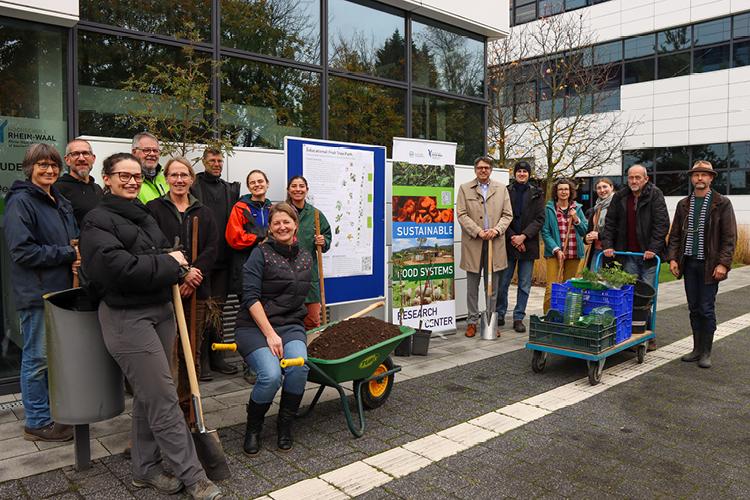
University President Prof. Dr Oliver Locker-Grütjen, members of the ‘Sustainable Food Systems’ research cluster and the Faculty of Life Sciences have come together for a tree-planting event to create a vibrant space for learning and discovery for students and staff as part of the ‘Greening the Campus’ initiative, with the aim of establishing the ‘Educational Fruit Tree Path – Future Fruit Trail’. Along the path, there are various themed areas, such as bee and insect hotels, flowers and fruits to engage all the senses, and a variety of fruit varieties that reflect the project’s culinary and ecological diversity.
The project aims to create a climate-resilient and biodiverse habitat on campus. Along the emerging ‘Future Fruit Trail’, various fruit trees are being planted, which have been carefully selected for their ability to adapt to climate change. Each tree is paired with suitable ground cover to achieve ecological synergies and mutual support between species through the principle of mixed and companion planting.
Furthermore, the trail is intended to serve as a vibrant place of learning and discovery: lecturers will incorporate the educational trail into their courses, whilst students can take study breaks here, enjoy seasonal fruit and, in future, access interactive information on species, care and harvest times via QR codes on the plants. The path is designed as a ‘Walk with all the Senses’ – a sensory trail that invites visitors to discover, smell, feel and taste. The planting initiative supports Rhein-Waal University of Applied Sciences’ contributions to the 2029 State Garden Show.
The project received expert and practical support from the LIKK association (Landschaftspflege im Kreis Kleve e.V.) and was actively backed by representatives of the City of Kleve. The original initiator was the Permakultur-Niederrhein e.V. association. Students Alina Maksimova, Nicole Stürmlinger and Delfina Andrada were responsible for designing the ‘Future Fruit’ educational trail.