
Winter semester: Depending on the authority: 1 July 2025 – 1 March 2026
Delete
Renew your ID card from the comfort of your sofa? Apply for parental allowance from your nursery? Submit a planning application paperlessly or vote online?
Do you think public administration is slow and uninnovative? Not at all! The digital transformation of public administration in particular needs young, creative minds like you who are keen to help shape the state of tomorrow. Our mission: a smart state that is efficient, digital and citizen-focused.
With the Administrative Informatics – E-Government (B.Sc.) degree programme, you can be part of this change. Together with various state authorities and local councils in North Rhine-Westphalia, we offer you an exciting, interdisciplinary course of study in which you’ll learn about modern concepts, methods and technologies – not just in theory, but also in practical application.
And best of all: right from the start, you’ll be involved as a civil servant and will be working directly within your future professional environment. Make a difference – for yourself and for society!
At a glance
Bachelor of Science
Dual
8 semesters semesters
Restricted
Kamp-Lintfort
German
1 September
Why study Delete at Rhine-Waal?


Programme structure and content
With your interdisciplinary knowledge – combining IT, organisation, law and communication – you have a wide range of opportunities.
You’ll be an expert in digital transformation within public administration – a career field with a bright future and growing demand, as the Online Access Act requires the federal government, the states and local authorities to offer their administrative services digitally. There is an urgent need for skilled professionals in this field – be part of it!
The Administrative Informatics – E-Government (B.Sc.) degree programme is offered in cooperation with the State of North Rhine-Westphalia, which is why your specific duties will vary depending on the training authority. Nevertheless, across all authorities, you will benefit from the advantages of the State of North Rhine-Westphalia as an employer, such as flexible working hours (for example, working from home or flexitime), numerous training courses to expand your skills, and an active health management programme.
In the first two semesters, you’ll learn everything you need to know about e-government. You’ll cover the basics of programming, practical computer science, business administration and law.
In the third and fourth semesters, you’ll really get stuck into the practical side of things: you’ll be able to apply what you’ve learnt at the training authorities and get involved in your first exciting projects in real-life settings.
From semesters five to seven, your focus will be on solving administrative problems. You’ll also learn how to conduct academic research – perfect for preparing for your Bachelor’s thesis in the eighth semester.
To be admitted to the course, you must first apply to the relevant authority. In the first stage of the procedure, this authority will decide on your admission as a trainee in career group 2, entry-level post, of the technical administrative IT service. The application deadline for admission to the trainee post is usually at the end of February or beginning of March.
In addition to being recruited by the authority, you must enrol at Rhine-Waal University of Applied Sciences. The following requirements apply:
- an Unrestricted university entrance qualification or an Entrance qualification for university of applied sciences
- a qualification recognised as equivalent
- or a vocational qualification, e.g. as a master craftsman or through technical college education
The following additional requirements apply to the dual E-Government degree programme in the block model:
- German language skills at level B2 (according to the Common European Framework – CEF)
You should also have:
- An interest in digital technologies and their practical application
- Analytical thinking and a passion for problem-solving
- Motivation to play an active role in shaping the public sector of tomorrow
- Team spirit and good communication skills
- A basic understanding of mathematics
- Knowledge of English is an advantage
Don’t worry: you don’t need to be a programming expert to get started with us. We’ll teach you all the essential basics during your studies. However, a certain level of mathematical understanding is important – you can’t get by without maths entirely.
But if it’s a lack of prior knowledge rather than interest or motivation that’s holding you back, you’re in good hands with us. We’ll teach you all the basics you need to successfully complete your degree.
Partners
We work in partnership with various local authorities across North Rhine-Westphalia and the following state authorities:
- Ministry of the Interior of North Rhine-Westphalia (IM)
- Higher Regional Court of Cologne (OLG Cologne)
- Ministry for Children, Youth, Family, Equality, Refugees and Integration of North Rhine-Westphalia (MKJFGFI)
- State Office for Nature, Environment and Consumer Protection of North Rhine-Westphalia (LANUV)
- Data Centre of the North Rhine-Westphalia Finance Administration (RZF)
- State Office for Salaries and Pensions of North Rhine-Westphalia (LBV)
- State Office for Central Police Services of North Rhine-Westphalia (LZPD)
- State Agency for Information and Technology of North Rhine-Westphalia (IT.NRW)
- State Road Construction Agency of North Rhine-Westphalia (Straßen.NRW)
- State Agency for Measurement and Calibration, North Rhine-Westphalia (LBME)
FAQ
Which programming languages will I learn?
The lecturer for each course decides which programming languages are taught.
Which books or materials should I read?
You can find recommended reading in the Module guide or directly in the lectures. You can download the Module guide here.
How do I get further information about the learning materials?
That depends on the lecturer. You will usually receive information about this at the start of the lecture. You will also find important information in the Module guide and often in the course’s Moodle platform.
Which tools are used for online seminars?
The university mainly uses Cisco Webex for online seminars. You can register for this free of charge via the university. Sometimes lecturers also use other programmes, usually those that are freely available.
Are there assignments during the semester break?
Not usually. However, there are sometimes deadlines for projects or assignments that fall during the lecture-free period.
What are the requirements for my laptop?
For your studies – particularly in the Web Development module – you should have the following laptop:
- Operating system: Windows or macOS and/or Linux (Linux is preferable, e.g. as a dual-boot or virtual machine)
- Processor: Intel Core i7 or AMD Ryzen 7 (or similar)
- Storage: 1 TB SSD
- RAM: 32 GB
- Ports: USB-C and HDMI (HDMI can also work with an adapter)
- A camera and microphone are required
A touchscreen, digital pen, fingerprint scanner, separate graphics card or a CD/DVD drive are not required. These requirements apply until the 2026/27 Winter semester.
Can I also undertake the dual study programme in the block model as an employee?
No, in the block model, the dual study programme is only available to civil servants.
How are study places allocated by the local authorities?
Study places are allocated by the relevant ministries of the North Rhine-Westphalia state government. Please contact the person listed there.
What happens after the selection process?
If you have passed the selection process, your training authority will notify the relevant ministry (MHKBD). You will then apply via the Rhine-Waal University of Applied Sciences online portal (expected to open in mid-May) and complete enrolment as soon as you receive your Letter of Admission. In addition to the usual documents (e.g. ID card, A-level certificate), you will also need a confirmation of appointment from your authority for enrolment. You can find a sample letter for this in the guidance for authorities. The university will check all documents – if anything is not in order, enrolment may be refused.
Who plans the practical phase and how does it work?
Your training authority is responsible for planning and organising your practical phase. Where possible, you should work on tasks and projects related to your degree programme. You will be supervised by a lecturer from the university, who will also assess your practical report. At the end, you will receive the result: pass or fail.
Campus
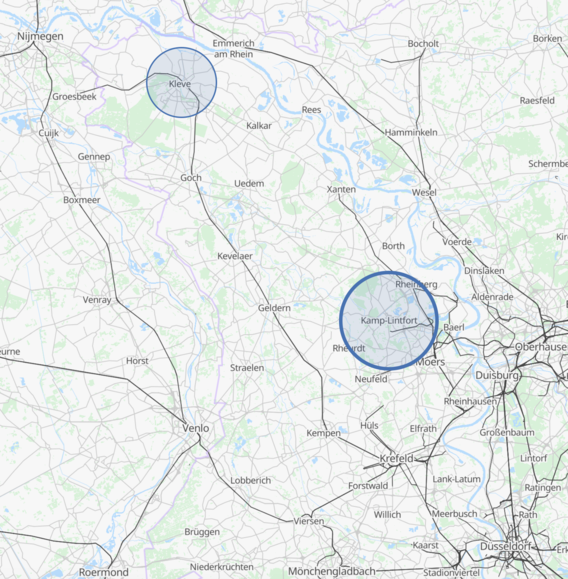
Kamp-Lintfort Campus