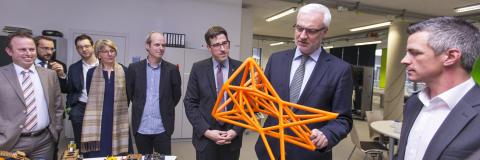
According to Garrelt Duin, Minister for Economic Affairs of North Rhine-Westphalia, the new Lower Rhine 3D Centre of Excellence brings together the three key ‘Cs’: ‘talent, expertise and capital’. Last year, it was the talent and expertise that convinced the state government to provide the necessary funding for the project, in which Rhein-Waal University of Applied Sciences, Ruhr-West University of Applied Sciences and RWTH Aachen University are collaborating. The state and the EU are funding the 3D Competence Centre with 3.3 million euros. No other project under the “Regio.NRW” call for proposals has received more funding, the Minister said today in front of 150 invited guests at the opening event in Kamp-Lintfort. Duin praised the practical training concept, which is being implemented in the so-called FabLabs – the high-tech workshops at the participating universities.
After all, this is about the technologies of the future. The digitalisation of numerous sectors in business, public administration and everyday life is advancing. According to the Minister for Economic Affairs, this makes it all the more important to train young people in the use of digitally controlled machines to such an extent that they can bring their own ideas to life themselves. This is one of the key tasks of the Lower Rhine 3D Competence Centre, which has 25 staff members across its three sites in Kamp-Lintfort, Bottrop and Aachen. Through a variety of workshops, children and young people – as well as students from the participating universities – are introduced to digital manufacturing methods. Primary school children build soapbox cars, whilst secondary school pupils learn to programme simple control systems and build their own 3D printers. Students use 3D printing, 3D scanners or laser cutters to bring their own projects to life – right through to their Bachelor’s or Master’s theses.
The 3D Competence Centre is designed to further drive forward the transfer of innovation, knowledge and technology between research and industry. It serves as a hub for all initiatives already in place in the region and utilises the production capabilities of the FabLabs to provide educational programmes for the skilled trades and industry. Dr Heide Naderer, President of Rhein-Waal University of Applied Sciences, is also convinced by the project’s concept: “We are making the best possible use of our resources and forging links between the faculty, schools and businesses. We are opening doors to the region.” The centre of excellence is a flagship for Kamp-Lintfort.
One key objective of the project is already being put into practice. Since January, the so-called Fab Academy has been taking place at the Kamp-Lintfort FabLab for the first time. The five-month training programme, developed at the Massachusetts Institute of Technology (MIT), covers all the key skills required to produce one’s own prototypes. Participants learn programming, 3D product design on a computer, how to use all digital production processes and how to work with different materials. The Lower Rhine 3D Centre of Excellence has awarded four scholarships to students at Rhine-Waal University of Applied Sciences to enable them to take part in the Fab Academy.