
Design students at Rhein-Waal University of Applied Sciences are creating wall murals for the ‘Joint Research Centre’
HSRW
Science meets art
Design students at Rhein-Waal University of Applied Sciences are creating wall murals for the ‘Joint Research Centre’
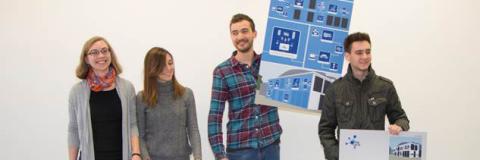
Kleve/Kamp-Lintfort, 4 March 2015: As part of a semester project led by Prof. Jörg Petri, Professor of Media Production at Rhine-Waal University of Applied Sciences, ten third- and fifth-semester students from the ‘Information and Communication Design’ programme developed various illustrations for the exterior wall of the European Commission’s ‘Joint Research Centre’ in Italy.
The aim of the semester project was to use a variety of illustrations to create an informative and design-oriented feature that would effectively convey the research areas housed within the building to visitors by displaying them on the building’s external wall and representing them visually. A jury comprising Darren McGarry, Head of Public Relations and Communications at the JRC; Dr Alois Krasenbrink from the Sustainable Transport Unit, a research institution of the European Commission; and Dipl. Des. Christian Stindl, assessed the various entries and selected the three most successful designs.
The three winning designs were developed by students Ines Czuia, Bianca di Giovanni, Benjamin Liebl and Nico Schröder, who are in their third and fifth semesters. Benjamin Liebl’s winning design features various pictograms relating to the ‘Electromobility’ research area. The aim is to highlight the diversity of the research field. “The communication challenge is complex. The institute’s diverse research field and its associated laboratories must be conveyed visually in such a way that even a passer-by with no prior knowledge can immediately understand what the researchers are working on there,” says Prof. Jörg Petri.
The design by Ines Czuia and Bianca di Giovanni focuses on connectivity as one of the key objectives for the future of European energy. Here, the cable, as a means of transport, becomes a symbol for the various areas. The illustrated symbols are created using a cable-like line. Thanks to the stylised representation, the symbols are easily recognisable from a distance and, even at night, catch the eye of visitors thanks to a special luminous paint.
Nico Schröder’s design explores the interconnectedness of the various sub-sectors of ‘electromobility’ in all its complexity. The diversity of research areas is visually represented by lines that form a network connecting sectors such as infrastructure, resource efficiency, electromobility and a standardised future.