These are designed to supply power to other implanted medical devices and also to provide electrical stimuli for nerve regeneration and regrowth by converting the movements and vibrations that every human body generates mechanically into electricity. Research in this field is being driven forward under the leadership of Dr Amir Fahmi, Professor of Materials Science at the university’s Faculty of Technology and Bionics. The new collaborative project ‘Bioteng’, in which universities from Estonia, Latvia and Russia are participating alongside Rhein-Waal University of Applied Sciences, has set itself the goal of developing so-called nanogenerators consisting of nanostructured biomaterials. Nanogenerators can convert small physical changes – triggered, for example, by movement – into electricity. In this way, they can supply power to implanted medical devices.
Nanogenerators need to be flexible, as they are implanted in soft tissue and must adapt to various movements there; they must also be as durable as possible. At the same time, however, the research project also aims to create biodegradable and bioresorbable nanogenerators, so that no undesirable side effects occur following implantation. Furthermore, these devices are being developed so that they are broken down by the body at the end of their life cycle. This eliminates the need for surgical procedures currently required to replace or remove implantable devices.
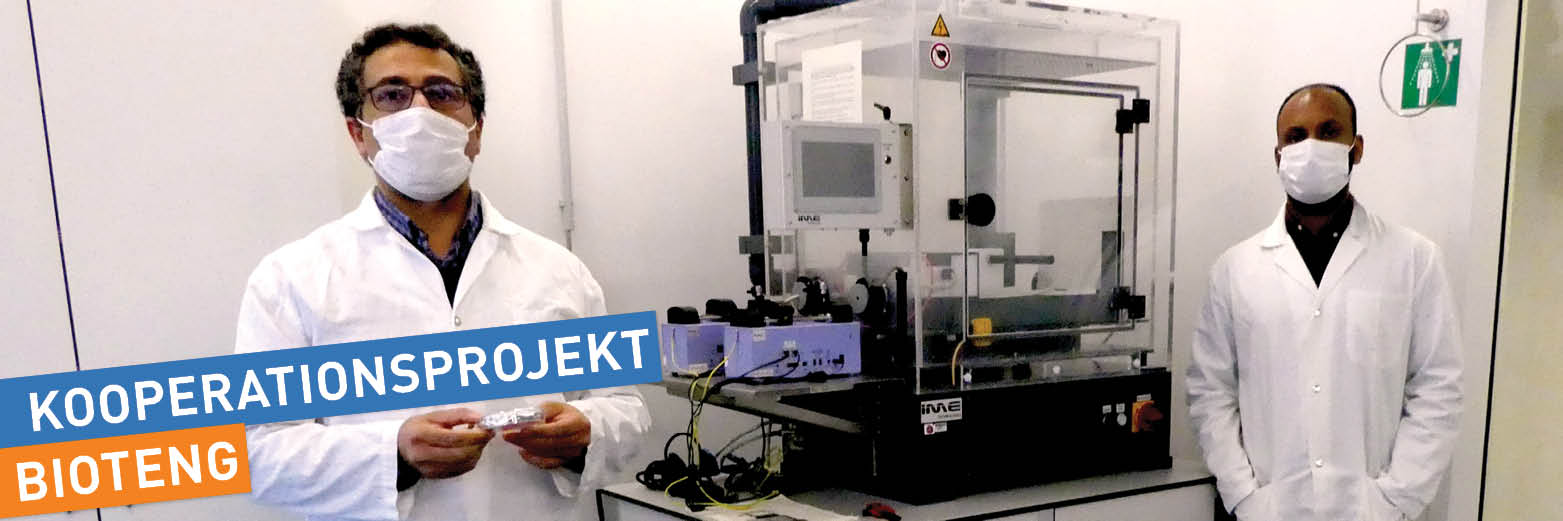
At Rhine-Waal University of Applied Sciences, Dr Viraj Pratap Nirwan is working on the project as a research assistant alongside Prof. Dr Amir Fahmi. The project is due to be completed in three years and is expected to lead to advances in the field of triboelectric nanogenerators and nanomaterials in general.
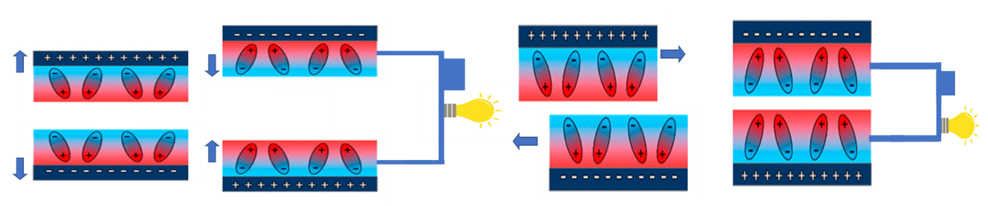
Illustration: The surfaces develop opposing charges that alternate, either through friction or by changing the distance between the triboelectric surfaces. If the surfaces are connected via an electrode to complete the circuit, current begins to flow. Electricity is therefore generated by mechanical action.
Image credits:
1: Prof. Dr Amir Fahmi (left) and Dr Viraj Pratap Nirwan, © Rhine-Waal
University of Applied Sciences 2: © Rhine-Waal University of Applied Sciences