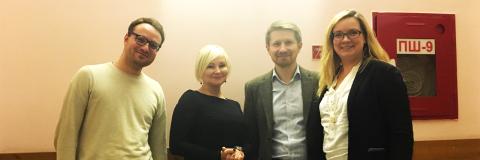
With 195,000 students and 5,000 lecturers, the Academy is one of Russia’s largest universities. It already maintains links with leading academic partners both at home and abroad, including, for example, LMU Munich. During her visit, Zimenkova held discussions with the Dean of the Faculty of Comparative Political Science, Dr Evgeny Roshchin; the Vice-Dean for Internationalisation, Dr Illya Matveev; and the Deputy Head of the International Office at the North-West Institute of Management, Irina Nikonova. The Institute, with its seven faculties, is roughly the same size as Rhine-Waal University of Applied Sciences and is interested in collaborating with the university in the fields of social and political sciences, gender studies and, where appropriate, economics.
The Russian faculty offers an English-taught Bachelor’s degree programme in Political Science and World Politics in St Petersburg, as well as a Bachelor’s degree in International Relations in Moscow, making it particularly appealing to students at Rhine-Waal University of Applied Sciences who wish to focus on Russian politics, society and economics during their studies. For students at the Academy, in turn, Kleve is a particularly attractive place to study, as it offers modules taught in English at Bachelor’s level that are compatible with their degree programmes – something that is absolutely unique in Germany. In addition, the Russian students can benefit from course content taught on the ‘Gender and Diversity’ programme, which is not offered at their home university.
The possibility of an Erasmus partnership is currently being explored, with the study programmes currently being assessed for compatibility. However, the aim is to organise an initial student exchange even before an Erasmus agreement is signed.