The “Klever Birne”, a collaboration between the TransRegINT project (Transformation of the Lower Rhine Region: Innovation, Sustainability, Participation) at Rhine-Waal University of Applied Sciences (HSRW) and the City of Kleve, had “Sharing Economy” as its theme this year. Residents of Kleve were invited to come up with creative ideas to demonstrate how sharing, swapping and community action can make the town more sustainable. The 22 entries show that the competition has once again been very well received in its third year. “Integration into the region is a key priority for the university. This also involves working with the City of Kleve to promote commitment to sustainable measures. I am delighted to see that the Sustainability Award is now recognised beyond the city’s borders,” said Prof. Dr Oliver Locker-Grütjen, President of HSRW, at the start of the final. Joachim Schmidt, Deputy Mayor of Kleve, emphasised the value of the prize and encouraged the teams ahead of their presentations: “Who knows, perhaps tonight we’ll find the next big inspiration for shaping our city’s sustainability right here.”
Each team had three minutes to present their idea and then answer questions from the jury. The audience also had a say: everyone present was invited to put forward their favourite idea for the People’s Choice Award. The ideas presented ranged from swap points, neighbourhood initiatives and networking platforms, through sensors for environmental data and a reusable cup scheme, to community-supported agriculture and food forests.
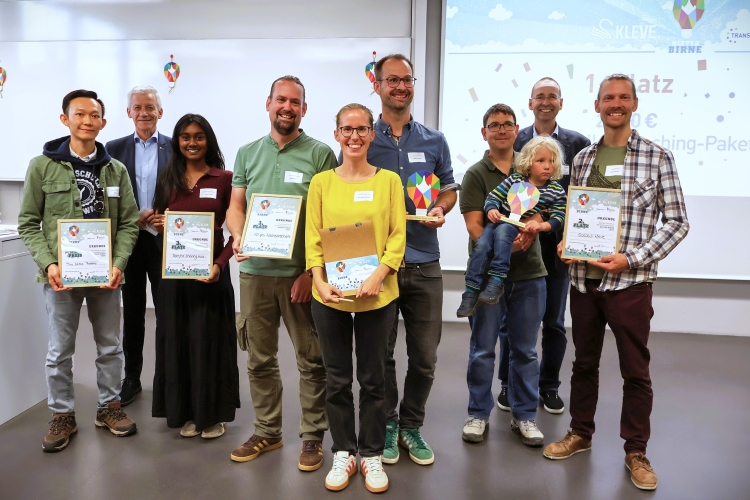
The jury withdrew to deliberate, whilst the final ballot papers for the audience award were placed in the ballot box. The winners were then announced by Joachim Schmidt and Dr Gerhard Heusipp, Head of the Centre for Research, Innovation and Transfer at HSRW and Deputy Project Manager of TransRegINT. First prize, worth €2,000 in prize money and a personalised coaching session, went to the ‘10 m² Neighbourhood’ initiative. Anna-Lena and Philip Frauenlob, together with Jan-Peter Heinz, aim to transform car parking spaces into vibrant neighbourhood meeting places using a mobile bicycle trailer. Why 10 m²? Cars occupy public space for 95 per cent of the day and take up a parking area of at least 2 m x 5 m = 10 m². The team is convinced: “As a society, we can make use of this space.” The prize money will go directly towards building the bicycle trailer. Their goal is clear: “We want to be ready in time for the next ‘Klever Birne’ festival and then roll in here with our trailer,” say the Kleve residents.
The celebrations were just as lively for the second-place team, the Solidarische Landwirtschaft Kleve association. This initiative centres on the harvest, which is to be distributed amongst the members. In return, they pay a membership fee and lend a hand, for example, on event days. The prize money of €1,500 will boost the association’s capacity to invest and is to be used to fund an irrigation system. Third prize, comprising €1,000 in prize money and coaching, went to “Sanjha – Sharing Hub”, an idea conceived by students Hannah S. David and Kirandeep Kaur. They aim to promote the sharing of items through swap stations and a companion app, as ‘Sanjha’ means ‘sharing’ in Hindi. The winner of the People’s Choice Award is also a student at HSRW: Hien Do impressed the judges with his idea of food forests. In this way, domestic gardens are transformed into valuable edible forests. Plans are already underway for the first such garden in Kleve.
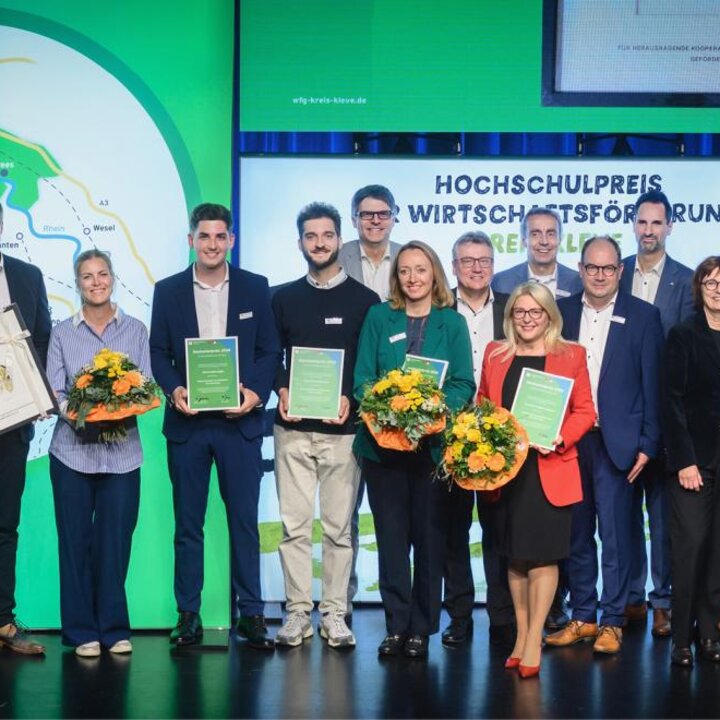
This year’s jury was a diverse group, enabling a range of perspectives on the ideas presented. The jury comprised Herbert Looschelders from the Kleve Social and Ecological Foundation, Dirtje Derksen from the Kleve District Climate Working Group, Nadja Brauer, educational director of the Kleve District Vocational Training Centre (BBZ), and Michael Gesikiewicz, neighbourhood manager at SOS Children’s Villages Lower Rhine.