
Students on the Master’s programme in “Health Sciences and Management” at the Faculty of Life Sciences travelled to the Zillertal in Austria.
HSRW
Exercise in the mountains can move mountains
Students on the Master’s programme in “Health Sciences and Management” at the Faculty of Life Sciences travelled to the Zillertal in Austria.
Kleve/Kamp-Lintfort, 15 July 2016: Walking is good for your health – this is not only something you can easily experience for yourself, but has also been confirmed by numerous studies. The health benefits extend to the body, the mind and the spirit. To enhance their well-being, people have therefore been drawn to the mountains for quite some time.
As part of a research project, students on the Master’s programme in ‘Health Science and Management’ at the Faculty of Life Sciences investigated the effects of hiking at medium altitudes of 1,000 metres and above on physical performance and the cardiovascular system. During a one-week stay in the Tyrolean Alps near Mayrhofen, the students investigated the effects of hiking on physical adaptation as part of an altitude training programme.
This study was scientifically supervised by Prof. Dr Robert Renner, programme director and professor of health promotion and nutrition at Rhein Waal University of Applied Sciences, and Heike Holtappel, a research assistant at the Faculty of Life Sciences.
Using portable spiroergometry, which measures various parameters for assessing the cardiovascular system, the participants covered a set distance uphill. In addition to the measurements taken with the portable spiroergometer, blood lactate levels, oxidative stress and antioxidant capacity were also assessed at specified time points. The aim was to verify the effects of altitude on physical exertion and the body’s ability to adapt to hill walking. The results confirmed the anticipated positive effects on the cardiovascular system and demonstrated an increase in individual physical performance.
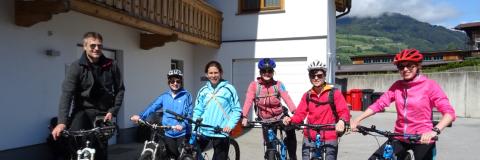
As well as their work on the research project, the participants were also able to gain further insights into the local area. The programme included a visit to Innsbruck, a mountain bike tour and a rafting trip on the white water of the Imster Schlucht gorge. “The research project in Austria encouraged independent and scientific work and helped us gain a great deal of practical experience. Although the week was very intense and exhausting, it was good for our teamwork and sense of community,” the students summarised upon their return to the university.