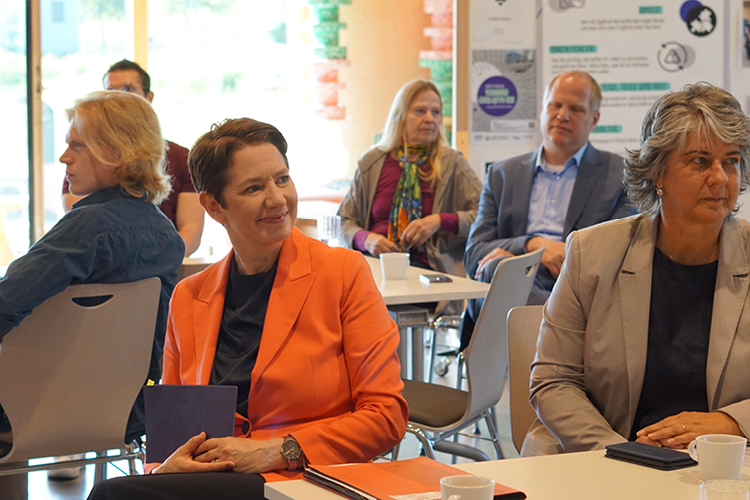
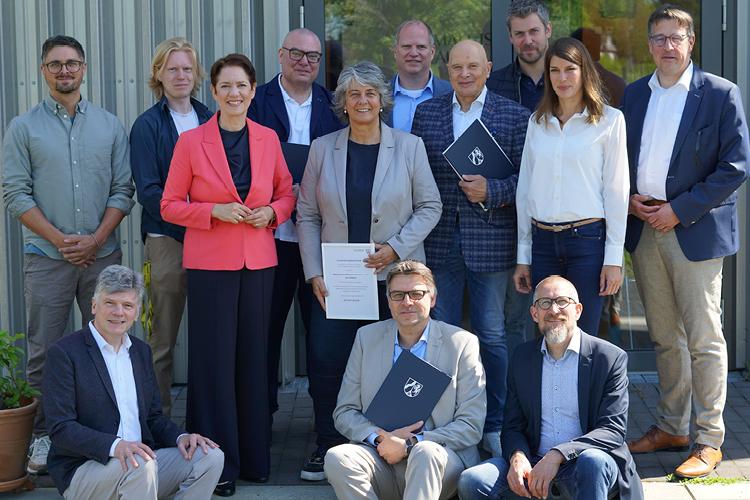
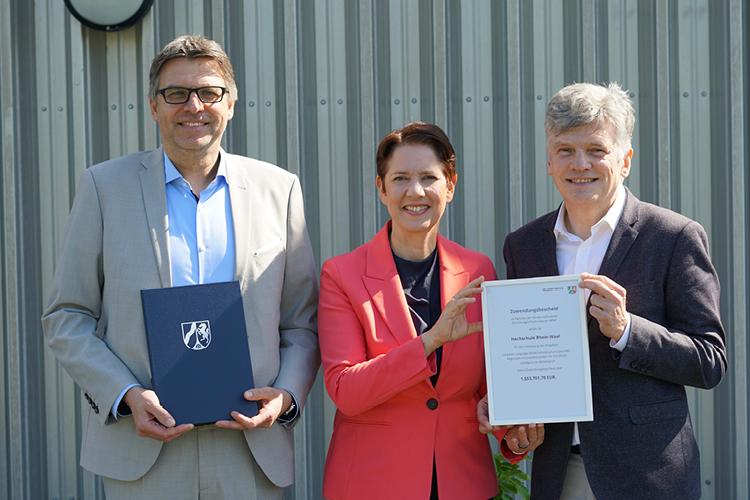
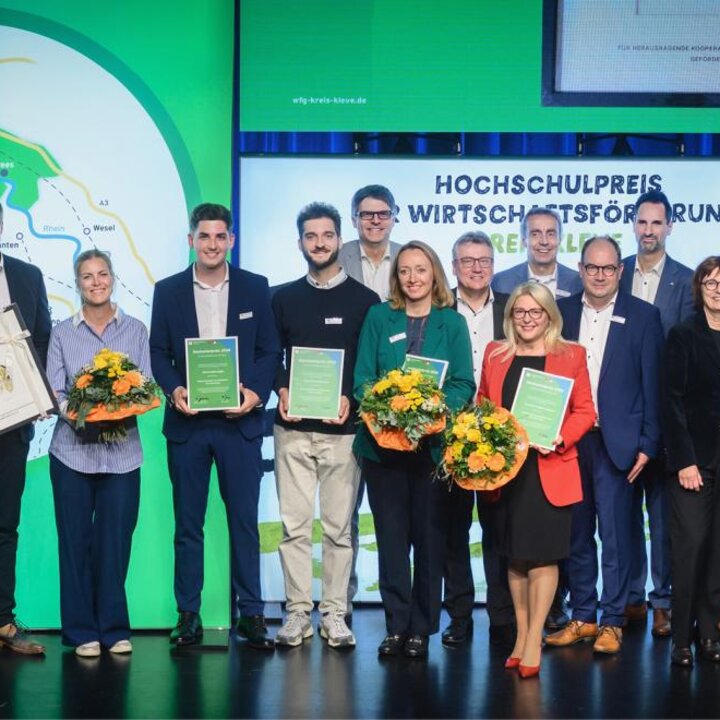
Prof. Dr Oliver Locker-Grütjen, President of HSRW, welcomed Minister Silke Gorißen, Member of the State Parliament René Schneider and the project partners to the Green FabLab on the Kamp-Lintfort campus. “I am delighted to be celebrating this special achievement by the university with you today,” said Locker-Grütjen. “‘Forschungsinfrastrukturen.NRW’ is an important funding programme for us as a university of applied sciences, given its practical focus and collaboration with regional SMEs. I would like to thank everyone involved who worked on the project proposal across both research areas and campuses.”
“Artificial intelligence has long been part of everyday life in horticulture, arable farming and forestry – drones and machines are already flying and driving across our fields, through our forests and in our barns, supported by AI,” said Minister Gorißen at the grant award ceremony. “The challenges facing the agricultural and food sectors are becoming increasingly complex. This makes it all the more important that we closely link research, innovation and practical application.”
The aim of the SALAMI project is to establish a scalable AI research and development infrastructure in the Lower Rhine region, which will serve as the basis for sector-specific and locally deployable applications in agriculture, administration, healthcare and industry; these will be addressed in individual implementation projects within the framework of the initiative. The focus is on concrete solutions for small and medium-sized enterprises – ranging from AI-supported robotics and precision farming to camera-based damage analysis. For example, field robots and drones can be used to detect plant diseases, damage caused by wildlife or drought stress on agricultural land at an early stage, and to make work processes more efficient.
The project relies on so-called Small Language Models (SLMs) – that is, compact, resource-efficient versions of large AI language models such as GPT or Gemini. Another aim is to actively help companies build up their own expertise in working with AI. This also strengthens European technological sovereignty. The project’s consortium leader, Prof. Dr.-Ing. Rolf Becker, emphasises: “I believe in the economic potential of small language models. This project will have an impact on the economic development of the Lower Rhine region.”
The collaborative project, funded by the European Union and led by Rhein-Waal University of Applied Sciences, has a total budget of 3.28 million euros and will run for three years. Of this, around 2.84 million euros will be provided through the funding programme.
The project partners are:
- Rhein-Waal University of Applied Sciences (Kleve / Kamp-Lintfort) for the accompanying scientific research and coordination of the project
- ORB gGmbH (Krefeld) for the agricultural aspects
- CODUCT Solutions GmbH (Kamp-Lintfort) for the public administration and healthcare components
- Marvelous Software Solutions (Kalkar) for the professional integration of migrant workers into apprenticeship schemes using AI applications in learning software
- GeSA mbH (Alpen) for camera-based damage analysis of vehicles, crane systems, historic buildings and PV modules
Background information: Research priorities
Two research priorities (FSP) have been established at Rhein-Waal University of Applied Sciences. The FSP ‘Sustainable Food Systems’ focuses, amongst other things, on working conditions in agriculture, food processing, the utilisation of waste materials, and innovative production systems such as ‘edible forests’ and 3D-printed food. The FSP ‘Assistance and Participation’ researches, designs and develops technical cognitive assistance systems that place people and their needs and values at the centre. What both research priorities have in common is that they involve cross-faculty and interdisciplinary collaboration between various scientific disciplines.