The writing competition, which was launched to coincide with the State Garden Show, is taking place for the fourth time this school year. ‘Green FabLab – I design the world the way I like it’ is this year’s competition theme. It is once again open to all Year 4 pupils at primary schools in Kamp-Lintfort. The aim of the competition is to spark and nurture a love of writing in children, thereby boosting their confidence in their own abilities and talents. The competition is initiated and organised by the LesART association. The competition is supported by the Cultural Office of the City of Kamp-Lintfort, Rhine-Waal University of Applied Sciences and Stadtwerke Kamp-Lintfort.
“Having focused on the 900th anniversary of Kamp Abbey last year, this time we are turning our attention to future technologies. With this special project, we aim not only to spark children’s interest in writing but also to foster an interest in resource-efficient, sustainable production, thereby raising their awareness of the impact of their own actions,” explains Christine Buyken from the LesART association, who is organising the competition in collaboration with the Cultural Office.
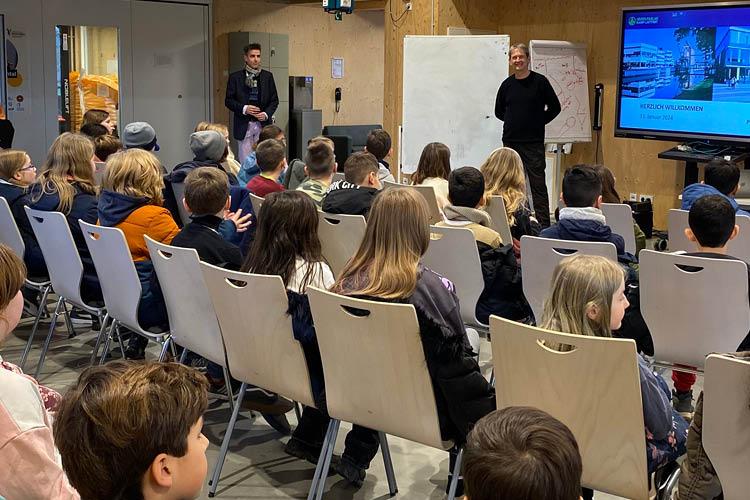
To mark the start of the competition, all Year 4 classes were invited to the Green Fab Lab to familiarise themselves with the workshop. Integrating the digital technologies of the future into schools in the Lower Rhine region whilst helping small and medium-sized enterprises secure the next generation of talent – that is the aim of the Green FabLab. The Green FabLab is a high-tech workshop for digital manufacturing that is consistently dedicated to environmental issues.
“There’s a lot to discover. We’re an experimental laboratory here, where a wide variety of objects, sensors or even machines themselves can be produced using computer-controlled machines,” said Prof. Dr Kai Tiedemann from Rhein-Waal University of Applied Sciences, introducing the pupils to the concept. He gave a lively description of how printing, cutting and crafting are carried out in the FabLab, for example using 3D printers, laser cutters, precision milling machines and cutting plotters – but also with drills, soldering irons and sewing machines. Using these tools, pupils can gain an understanding of industrial production and techniques, and – just like real researchers – carry out technical and scientific experiments and create something new.
Over the coming weeks, around 400 pupils, inspired by their experiences at the Green FabLab, will put their inventive spirit and ideas into words and pictures. The stories must be submitted by the schools by 15 March.
A jury will select the most imaginative and creative stories. The awards ceremony will take place on 21 June. Some of the stories will then be published in a book, which will be distributed to the participating classes. “We are very excited to see what worlds the children will create, given the digital and technical possibilities available to them. The book we are sponsoring will give the stories a wider audience. The prospect of having one’s own story published in a printed book boosts motivation to write,” says Judith Dohmen-Mick, a jury member and press spokesperson for Stadtwerke Kamp-Lintfort.