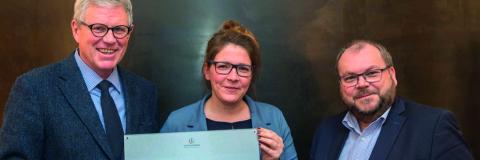
Diversity amongst students at German universities has long been a reality. Consequently, fostering student diversity has become a key priority in university development. This applies in particular to the internationally oriented Rhine-Waal University of Applied Sciences. The ‘Shaping Diversity’ audit by the Stifterverband für die deutsche Wissenschaft supports and advises universities on developing strategies, structures, programmes, tools and measures for diverse student groups, integrating these groups into everyday university life and helping them to succeed in their studies. This is also the case for the Rhine-Waal University of Applied Sciences, which has now successfully completed the process. “We are proud of this award. It demonstrates how important this issue is to us and how firmly the appreciation of diversity is already structurally embedded in the university’s strategy,” emphasises Professor Dr Georg Hauck, Vice-President for Human Resources Development, Organisational Development and Diversity, who, as project leader, accepted the certificate in Berlin.
The importance of this issue at Rhein-Waal University of Applied Sciences is demonstrated, amongst other things, by the thorough consideration given to diversity-specific issues and objectives in its mission statement and in the university’s development plan. These documents set out the structural framework for development over the coming years. “The principle of diversity is integrated into the university’s existing structures, processes and content; it is understood in a multidimensional and context-specific manner and implemented sustainably in line with the learning and effectiveness approach,” explains Tammy Schmack, a research assistant responsible for project management.
As part of the audit, the focus was on the themes of internationality and educational background. In the first stage, the analyses and action planning centred on the aspect of internationality. This also plays a key role in the university’s development plan and shapes the university’s profile. The measures encompass both organisational processes and initiatives tailored to specific target groups. “Carried out in parallel with the development of our university development plan, the audit provided an ideal opportunity to develop and test targeted steps towards implementing our diversity strategy. The certificate is therefore recognition of our achievements, but at the same time a commitment for the future,” said Professor Hauck.