Snoezelen, a Dutch term derived from ‘snuffelen’ (to discover/explore) and ‘doezelen’ (to doze/relax), is a therapeutic method developed in the 1980s by two Dutchmen (Ad Verheul and Jan Hulsegge). It was originally used for people with severe mental or physical disabilities, but is now increasingly being applied to children and older people, as well as in psychiatric settings. Gentle stimulation of various senses in a room specially designed for this purpose is intended to convey a sense of safety and security, thereby promoting relaxation. The method, which has undergone continuous development and is now practised in over 30 countries, is also increasingly the focus of research.
Under the supervision of Professor Dr Nele Wild-Wall, Professor of Research Methods and Diagnostics in Psychology, and Professor Dr Christian Ressel, Professor of Ambient Intelligent Systems, and in collaboration with Johannes Pfeifer, a research assistant on the Psychology programme, a group of eleven students from the Master’s programme in Information Engineering and Computer Science and the Bachelor’s programme in Psychology has now carried out a scientific investigation into the Snoezelen method as part of a project. As part of the preparatory work, the international and interdisciplinary team from Rhine-Waal University of Applied Sciences took part in a workshop at the ‘De Hartenberg’ Snoezelen Centre in the Netherlands, where Ad Verheul introduced them to the methodology.
Subsequently, part of the group, in collaboration with the Bönninghardt School – a special needs school in the Wesel district specialising in intellectual development, located in Alpen – investigated the impact of Snoezelen on the pupils’ behaviour. Over a period of six weeks, five students observed lessons at the school on a total of six days, divided into three groups, under the supervision of specialist teacher Karin Veltkamp. They observed the social behaviour, emotional expressions, concentration, and aggressive and stereotypical behaviour of the pupils, aged between 12 and 21. Using observation forms, they recorded in detail whether, and in what way, behavioural changes occurred following a 45-minute session in one of the school’s Snoezelen rooms.
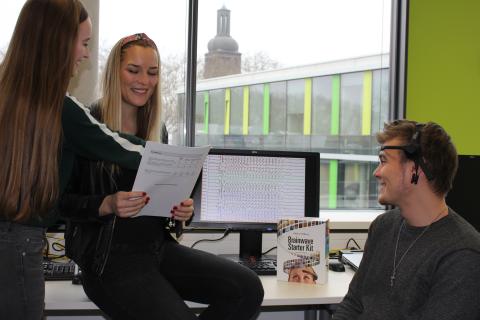
The other part of the project group set up a small Snoezelen room in the psychology laboratory at Rhein-Waal University of Applied Sciences and invited volunteers to take part in an experiment – an investigation into Snoezelen as a relaxation method using portable brainwave monitoring. Using an electroencephalogram (EEG), the electrical activity of the participants’ brains was measured at specific points before, during and after their visit to the Snoezelen room. The 21 volunteers in total were asked to spend 20 minutes in the room for this purpose. The data analysis provides insights, amongst other things, into the participants’ state of concentration or relaxation and allows conclusions to be drawn as to whether and to what extent Snoezelen led to relaxation.
The results of the studies suggest that Snoezelen has a positive effect on the ability to concentrate and reduces the occurrence of stereotypical behaviours. Across all the groups observed at the Bönninghardt School, there was, on average, a marked reduction in stereotypical behaviours following the Snoezelen session. A significant improvement in concentration was also observed, as well as a positive influence of Snoezelen on social behaviour and aggression. The data from the laboratory experiment, as shown on screen, reveal that brain activity frequencies associated with mental strain are reduced during Snoezelen. Consequently, the method can make an important contribution within the context of therapeutic interventions, whilst also offering avenues for relaxation to people without specific disabilities.
The students also used the findings to make recommendations for the further design of the Snoezelen rooms at the Bönninghardt School. Among other things, they propose reducing the number of colours, using predominantly white, and removing or replacing coloured elements and decorations. The redesign is intended to minimise background stimuli, highlight relevant stimuli and make the room appear more spacious. The students also consider it important to include auditory elements, such as an ocean drum, and stimulating elements such as a gentle swing or seesaw. Furthermore, they recommend using the furnishings to distinguish between the two Snoezelen rooms, designating one as a stimulating space and the other as a relaxing space.