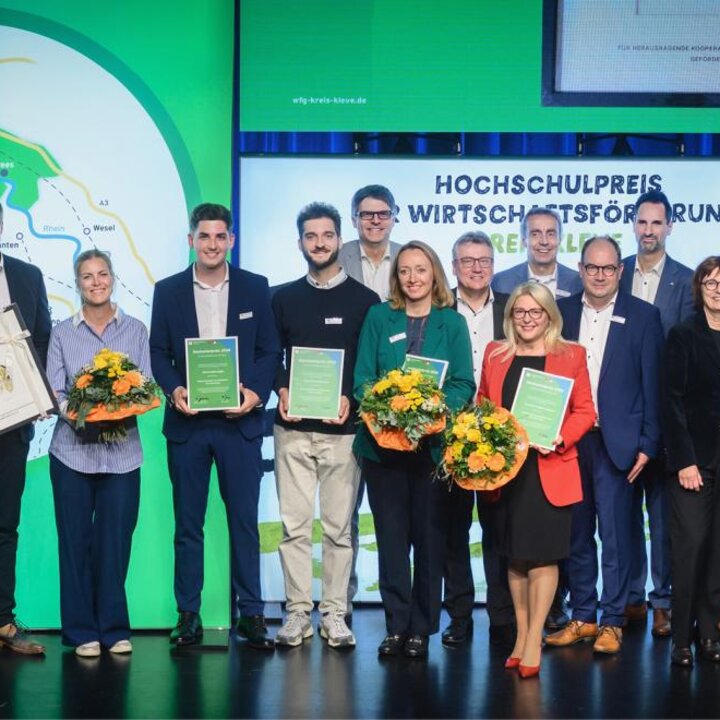
As part of the Ethics Talk, representatives from the worlds of business, politics and the sector discussed the implications of supply chains. Dr Dorothee Schröder-Krings (Senior Editor at the Rheinische Post), Claudia Brück (Chief Executive of Fairtrade Germany), Kirsten Wittke-Lemm (Lower Rhine Chemical and Metal Industry Association), Prof. Dr Christoph Landscheidt (Mayor of Kamp-Lintfort and Vice-President of the German Association of Towns and Municipalities), and Dr Günther Bergmann (Member of the State Parliament) noted that values are not a luxury, but provide the necessary guidance in times of multiple crises. Members of the public were able to ask questions and subsequently engage in dialogue with the experts.
On the second day of the event, the issue was examined from various academic perspectives. In his keynote speech ‘Responsibility requires data: transparency in supply chains as an information problem’, Dr Nikolaj Otte (expert in quantitative sustainability, ecoimpuls) illustrated the topic using the example of washing machines. He highlighted the differing interests of the various stakeholders, as well as the opportunities and risks associated with data collection.
In a range of workshops, students and members of the public were able to deepen their knowledge and discover new perspectives. The programme covered a wide range of topics and included workshops on ‘Nature as a Legal Entity – New Perspectives on Responsibility in Global Supply Chains’, ‘Heating in Germany: De-risking, Energy Security and Climate Protection – Do They Go Hand in Hand?’, ‘Experiencing algorithmic value creation in practice: AI platforms put through an ethical reality check’, ‘Who bears responsibility? Ethics in the development of digital assistive technology’ and ‘NGT1 – What does the new genetic engineering mean for supply chains, freedom of choice and labelling options?’.
Prof. Dr Locker-Grütjen, President of Rhine-Waal University of Applied Sciences, thanked everyone involved and emphasised: “The world is in a state of perpetual crisis. It is therefore important to discuss values, interdependencies and chain reactions, and to shed light on different issues and perspectives. I am delighted that events such as Ethics Day provide the necessary space for this.”
Special thanks go to the three friends’ associations of Rhine-Waal University of Applied Sciences and the Rotary Club Kamp-Lintfort/Grafschaft Moers for their support of the events.
Presentations from the event:
- Prof. Dr Thorsten Niechoj and Arslan Austin – “Empirical Evidence on EU SMEs” DE
- Prof. Dr Thorsten Niechoj and Arslan Austin – “Empirical Evidence on EU SMEs” ENG
- Prof. Dr Irmgard Buder – “De-risking and Energy Security”
- Dr David Spencer and Prof. Dr Natalie Laibach – “NGT1 | New Genetic Engineering”
- Prof. Dr Daniela Lud and Prof. Dr Mona Wappler – “Selective Dismantling | Leverage for Circularity”
Event 13:00 – Presentations a to c
- Prof. Dr Nele Wild-Wall – “Ethics and Responsibility”
- Prof. Dr Matthias Krauledat and Prof. Dr Matteo Große-Kampmann – “AI supply chains”
- Prof. Dr Alexander Brand and Prof. Dr Hegemann – “Disruptions in transatlantic chains of ideas and values”
Workshops 3.00 pm
- Dr Caroline Breidenbach – “Nature as a Legal Entity”
- Prof. Dr Irmgard Buder and Thomas Klimeck – “De-risking and Energy Security”
- Prof. Dr Matteo Große-Kampmann – “An ethical reality check on AI supply chains”
- Prof. Dr Nele Wild-Wall – “Ethics and Responsibility”
- Dr David Spencer and Prof. Dr Natalie Laibach – ‘NGT1 | New Genetic Engineering’