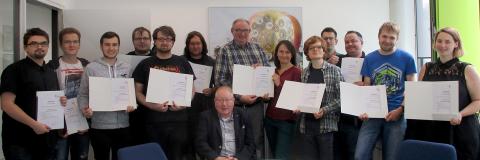
As part of the new module ‘Innovative Approaches in Media Informatics, with a focus on Qualification as a Data Protection Officer’, students on the Administrative Informatics – E-Government and Media Informatics degree programmes who had taken part in the seminar passed the certificate examination. The module coordinator and Professor of IT Law at Rhine-Waal University of Applied Sciences, Professor Dr Dieter Kopetz, led the seminar using a nationally standardised curriculum based on the General Data Protection Regulation (GDPR).
In addition to studying specialist literature, the students engaged intensively with the roles and responsibilities of a Data Protection Officer and delivered various presentations. As part of role-plays, the content of which had been developed in advance by the students, they also simulated authentic consultation sessions. External representatives from the Ministry of the Interior of the State of North Rhine-Westphalia and the Data Protection Officer of Rhine-Waal University of Applied Sciences took part in the role-plays; during a visit, they exchanged views with the students and provided them with helpful practical advice. At the end of the module, a total of twelve students were delighted to receive their certificates.
The qualification they have acquired enables them to carry out data protection impact assessments in future, plan technical and organisational safeguards, conduct consultations on data protection law, and work as data protection officers. The seminar was offered for the first time in the summer term of 2019 as part of a compulsory elective programme at the Faculty of Communication and Environment. The topics of information processing, data security and optimisation processes form part of the curriculum in both Bachelor’s degree programmes. Professor Kopetz plans to continue the module in the summer term of 2020 and, beyond that, to offer compulsory further training for data protection officers as a one-day course, for example in the form of a specialist conference. “This additional seminar programme could be an interesting alternative, particularly for external data protection officers – whose numbers are steadily growing in Europe – alongside the programmes offered by private educational providers and professional associations,” said the professor of IT law.