

Winter semester: Depending on the authority: 1 July 2025 – 1 March 2026
E-Government, BSc (Dual-vocational)
Study and vocational training for tomorrow’s IT all-rounders in public administration.
Renew your ID card from the sofa? Apply for parental allowance from home? Submit a planning application without any paperwork – or even vote electronically? This is what the future of public administration could look like.
Think public administration is slow and stuck in the past? Think again! The digital transformation of public services needs young, creative minds like you who want to help shape the government of tomorrow. Our mission: smarter public services that are efficient, digital and designed around people.
With the Bachelor’s degree programme in E-Government, BSc, you can be part of this transformation. Working with state authorities and local government organisations across North Rhine-Westphalia, we offer an exciting interdisciplinary programme where you’ll explore modern concepts, methods and technologies – not just in theory, but through hands-on experience too.
And there’s more: right from the start, you’ll be part of the public sector as a trainee civil servant and gain practical experience in your future professional environment. Make a difference – for yourself and for society.
Please note that eligibility for civil servant status depends on your nationality and other legal requirements.
At a glance
Bachelor of Science
Dual
8 semesters
Unrestricted admission (no Numerus Clausus)
Kamp-Lintfort
German
1 September
Why study E-Government, BSc (Dual-vocational) at Rhine-Waal?

Programme structure and content
With your interdisciplinary expertise – combining IT, organisation, law and communication – you’ll have plenty of career opportunities.
You’ll become an expert in the digital transformation of public administration – a future-focused field with growing demand. Germany’s Online Access Act requires federal, state and local authorities to make their administrative services available digitally. Skilled professionals are urgently needed to make this happen – and you could be one of them!
The E-Government, BSc programme is offered in cooperation with the State of North Rhine-Westphalia, so your specific responsibilities will depend on the public authority you train with. Wherever you work, you’ll benefit from the advantages of the State of North Rhine-Westphalia as an employer, including flexible working arrangements such as working from home and flexitime, a wide range of professional development opportunities and active workplace health management.
Please note that eligibility for civil servant status depends on your nationality and other legal requirements.
In the first two semesters, you’ll learn everything you need to know about e-government. You’ll be introduced to the basics of programming, practical computer science, business administration and law.
In the third and fourth semesters, you’ll really get stuck into the practical side of things: you’ll be able to apply what you’ve learnt at the training authorities and get involved in your first exciting projects in a real-world setting.
From the fifth to the seventh semester, your focus will be on solving administrative problems. You’ll also learn how to conduct academic research – the perfect preparation for your Bachelor’s thesis in the eighth semester.
To be admitted to the programme, you first need to apply to one of the relevant public authorities. The authority will decide whether you are accepted as a trainee civil servant in the technical E-Government service (career group 2, first entry level). Applications for these trainee positions usually close in late February or early March.
In addition to being accepted by a public authority, you’ll also need to enrol at Rhine-Waal University of Applied Sciences. You’ll need one of the following qualifications:
- a German university entrance qualification (Allgemeine Hochschulreife or Fachhochschulreife)
- an equivalent recognised qualification
- or a relevant vocational qualification, for example a Meister qualification or a qualification from a Fachschule
- German language skills at B2 level (Common European Framework of Reference for Languages – CEFR)
You should also bring:
- an interest in digital technologies and their practical applications
- analytical thinking and a passion for solving problems
- motivation to help shape the future of public administration
- strong teamwork and communication skills
- a basic understanding of mathematics
- English language skills are an advantage
Don’t worry: you don’t need to be a programming pro to get started. We’ll teach you all the essential foundations during your studies. A basic understanding of maths is important, though – there’s no getting around it completely.
If you’re simply missing some prior knowledge but have the interest and motivation, you’ll be in the right place. We’ll help you build the foundations you need to succeed in your studies.
We work in partnership with various local authorities across North Rhine-Westphalia and the following state authorities:
- Ministry of the Interior of North Rhine-Westphalia (IM)
- Higher Regional Court of Cologne (OLG Cologne)
- Ministry for Children, Youth, Family, Equality, Refugees and Integration of North Rhine-Westphalia (MKJFGFI)
- State Office for Nature, Environment and Consumer Protection of North Rhine-Westphalia (LANUV)
- Data Centre of the North Rhine-Westphalia Finance Administration (RZF)
- State Office for Salaries and Pensions of North Rhine-Westphalia (LBV)
- State Office for Central Police Services of North Rhine-Westphalia (LZPD)
- State Agency for Information and Technology of North Rhine-Westphalia (IT.NRW)
- State Road Construction Agency of North Rhine-Westphalia (Straßen.NRW)
- State Agency for Measurement and Calibration of North Rhine-Westphalia (LBME)
Which programming languages will I learn?
The programming languages taught during the programme are chosen by the lecturers for each individual course.
Which books or materials should I read?
You’ll find recommended reading in the Module Catalogue or directly in your lectures.
Where can I find more information about learning materials?
This depends on the lecturer. You’ll usually receive more information at the beginning of each course. You can also find important details in the Module Catalogue and often in the Moodle course for the respective module.
Which tools are used for online seminars?
The university mainly uses Cisco Webex for online seminars. You can register free of charge through the university. Lecturers may occasionally use other platforms, most of which are freely accessible.
Will I have assignments during the semester break?
Usually not. However, deadlines for projects or term papers may sometimes fall within the lecture-free period.
What are the laptop requirements?
For your studies – particularly for the Web Development module – your laptop should meet the following specifications:
- Operating system: Windows, macOS and/or Linux (Linux is preferable, e.g. as a dual-boot system or virtual machine)
- Processor: Intel Core i7 or AMD Ryzen 7 (or equivalent)
- Storage: 1 TB SSD
- RAM: 32 GB
- Ports: USB-C and HDMI (HDMI via an adapter is also fine)
- Camera and microphone are required
You won’t need a touchscreen, digital pen, fingerprint scanner, dedicated graphics card or CD/DVD drive. These requirements apply up to and including the winter semester 2026/27.
Can I complete the dual study programme in the block model as an employee rather than a civil servant?
No. The dual study programme in the block model is only available with civil servant status.
How are study places with local authorities allocated?
Study places are allocated by the responsible ministries of the State Government of North Rhine-Westphalia. Please contact the person listed there for further information.
What happens after I pass the selection process?
Once you have successfully completed the selection process, your training authority will register you with the responsible ministry (MHKBD). You then apply through Rhine-Waal University of Applied Sciences’ online application portal, which is expected to open in mid-May, and enrol once you receive your letter of admission.
For enrolment, you’ll need the usual documents, such as your ID and school-leaving certificate, as well as confirmation of employment from your training authority. A template for this confirmation can be found in the guidance document for public authorities. The university will check all your documents and may reject your enrolment if the requirements are not met.
Who organises the practical phase and how does it work?
Your training authority is responsible for planning and organising your practical phase. Wherever possible, you’ll work on tasks and projects related to your studies. A lecturer from the university will supervise you and assess your practical phase report. At the end, you’ll receive a pass or fail result.
Campus
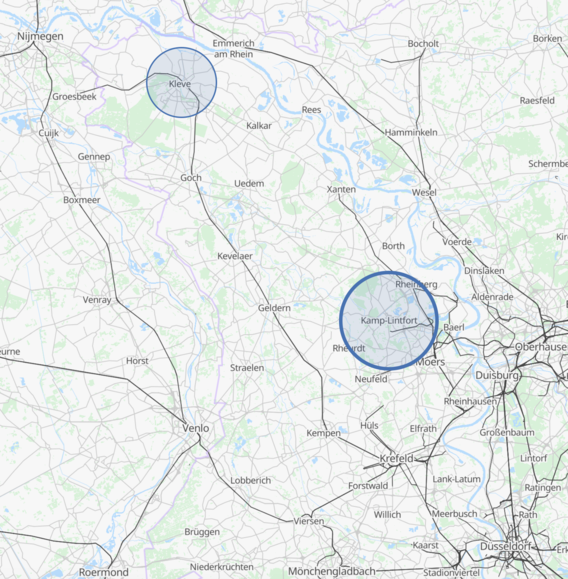
Kamp-Lintfort Campus
Related degree programmes

Student information

All about your studies
Bridging courses are intensive courses designed to help you prepare for your degree before your studies begin. Participation is voluntary and no credit points are awarded. You can use the courses to refresh your existing knowledge and fill in any small gaps before starting your studies.
The courses are held before the start of the winter semester, usually in September. The upcoming course programme will be available at the link below in due course.
The office of the examination board is the central point of contact for all questions and inquiries regarding examinations at your Faculty (Faculty of Communication and Environment).
Office of the Examination Board
On their website you will also find an overview of your first points of contact for various examination-related matters.
Overview
There is also a central Examinations Service for the entire University. It handles the administrative implementation of decisions made by the Examination Board and manages examination-related processes.
Examination Service
Your Faculty of Communication and Environment and the University’s central services offer advice and support throughout your studies – whether you need help with academic matters or personal challenges.
Advice and support services offered by the Faculty
Do you have any questions about your degree programme or exam-related matters? Are you experiencing issues with lecturers, or are you looking for personalised advice? Here you’ll find an overview of the key points of contact within the Faculty of Communication and Environment.
Services offered by the Faculty
Central advisory services
The university’s central advisory services are here to support you with a wide range of topics during your studies and beyond. Whether you need help with finding academic literature, developing a business idea, dealing with mental health challenges, studying with children or a disability, or have questions about anti-discrimination, you’ll find the right contacts and support for different situations in your studies and everyday life.
Central student services
The Central Student Services team is your main point of contact for organisational and administrative questions about your studies. They can help you with applications and admission, enrolment and deregistration, re-registration and leaves of absence, changing degree programmes, as well as questions about semester fees, certificates or health insurance notifications.
Contact
Programme Assistant
Ms Petra Kastowsky
Tel: 02842/908259821
petra.kastowsky(at)
Office hours (room number 02 00 455)
Monday–Thursday: 10.00–12.15 and by appointment
Monday, Tuesday, Thursday: 13.30–15.00 and by appointment