Kleve/Kamp-Lintfort, 28 July 2015: Students from the ‘HSRW Submarine Team’ at the Faculty of Technology and Bionics at Rhein-Waal University of Applied Sciences enjoyed a huge success at this year’s ISR in Washington. Six members of the twelve-strong ‘HSRW Submarine Team’ took part in the international submarine race with their self-built submarine ‘INIA’ – the only German university to do so – securing a fantastic second place and thus holding their own against a total of 23 teams from eight countries. “We have invested a great deal of time in further developing and improving the submersible and its bionic propulsion system. It motivates us time and again to take part in competitions and even to win an international prize,” says Leandra Hamann, a student on the Master’s programme in Bionics/Biomimetics. As the only female pilot in the race, Leandra Hamann was also awarded first prize in the ‘Non-Propeller Female (University)’ category.
For five days, the “HSRW Submarine Team” had the opportunity to compete against 23 other teams in several technical competitions and sporting races with their self-built submarine. Following an initial ‘dry and wet check’, the team took to the 100-metre-long race course, where the submarine operated at depths of up to 6.5 metres. After carrying out minor repairs and improvements, the first race was successfully completed, followed by a further nine starts.
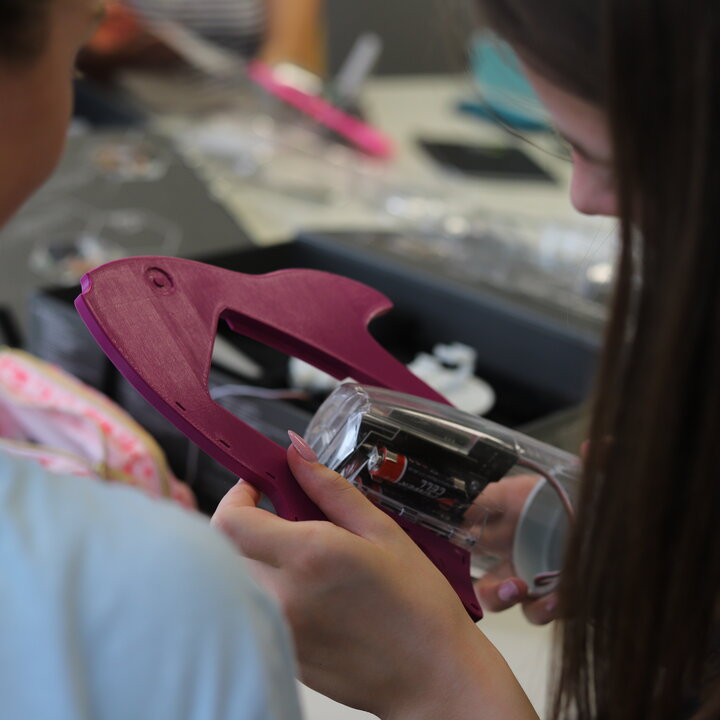
On the final day, the team replaced the submarine’s fins for strategic reasons. The fins initially used were modelled on a sailfish and had been specifically designed for higher speeds. However, the design of the fins to achieve top speeds came at the expense of stability, which is why they were unable to withstand the high propulsive forces generated by the pilot over the first four days. Consequently, for the final day of racing, the team used new fins, modelled on a river dolphin, which were specifically designed for rapid acceleration. This change in strategy proved to be the right decision, and the team ultimately secured second place.
Last year, the students had already won the ‘Outstanding Innovation Prize’ with their submersible at the European International Submarine Races (eISR) in the UK. Since then, the students have spent a year working on their submarine ‘INIA’ and further developing its functions. The windows through which the pilot views the race course were replaced, the control and safety systems were updated and checked, and a new, more efficient propulsion mechanism was designed and built. ‘INIA’ has the body shape of a tuna and the fins of a dolphin. What makes this submersible unique is its special propulsion mechanism. This was meticulously engineered and, unlike many submersibles, the ‘INIA’s’ fins are used for propulsion, offering an alternative to conventional propellers. The pilot is inside the submersible and propels it using their own muscle power. One of the rules and criteria for taking part in the competition was therefore that a purely human-powered submersible had to be presented.
The students also presented their submersible at this year’s Hannover Messe, the world’s largest technology fair. There, ‘INIA’ was showcased at a joint bionics stand alongside the Westphalian University of Applied Sciences, the University of Bremen and the company AIRBUS. The bionics stand was organised by the research consortium and bionics competence network ‘BIOKON’.
Further information and videos can be found online at www.subrace.eu or on the Facebook fan page of the participating students under ‘HSRW Submarine-Team’.