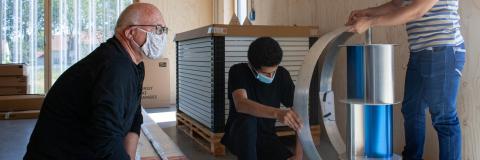
The Green FabLab at Rhein-Waal University of Applied Sciences, located on the site of the 2020 Kamp-Lintfort State Garden Show, is offering a series of workshops on building a small vertical wind turbine. From 30 July, visitors to the State Garden Show are invited to take part in the theoretical preparatory work at the Green FabLab every fortnight at 10.00 am.
Wind is currently the most important source of sustainable energy. People have been using wind energy since at least the early Middle Ages to grind grain or pump water. When connected to a generator, a wind turbine can be used to generate electricity. At the Green FabLab, visitors to the State Garden Show can now take part in a series of workshops to lay the theoretical foundations for a small vertical wind turbine known as a ‘Savonius-Darrieus hybrid’. This wind turbine combines an airfoil-shaped Darrieus rotor with a barrel-shaped Savonius rotor. The Darrieus rotor utilises the principle of an airfoil, just like an aeroplane. The Savonius rotor is used to get the wind turbine up to speed until the Darrieus rotor becomes effective.
The first workshop begins on 30 July at 10.00 am. Subsequent sessions will then take place every fortnight on Thursdays at 10.00 am at the Green FabLab. No registration is required. Face coverings must be worn. The workshop series is led by Detlef Lau, a member of staff at the Green FabLab.
Participants will work together to explore and discuss key issues relating to the project, such as: the installation of a brake to prevent storm damage to a wind turbine whilst it is in operation; the construction of a sufficiently tall mast; the collection of measurement data for scientific insights; safety aspects and risk analysis; and the application process for a permit for a single wind turbine smaller than 10 metres.
The question of how to utilise the energy generated by the small-scale wind turbine is also being explored. Options include direct use, storage in batteries or other systems, or connection to the electricity grid.
This project is funded by the European Regional Development Fund (ERDF)