During her visit to Rhein-Waal University of Applied Sciences, Isabel Pfeiffer-Poensgen, North Rhine-Westphalia’s Minister for Culture and Science, discussed current issues relating to student life, teaching and research with the university’s Executive Board and deans. She highlighted the outstanding achievements in establishing an international and multicultural university in the Lower Rhine region and expressed her gratitude to the university for its “hard work and efforts in successfully tackling the challenges of the COVID-19 crisis, particularly given the large number of international students”. The Minister was impressed by the commitment shown by the university and the region, as demonstrated, for example, by the joint COVID-19 relief fund, which provides students with immediate financial assistance, as well as by students’ involvement as harvest workers or in supporting schools.
The university’s president, Dr Oliver Locker-Grütjen, emphasised the importance of Rhein-Waal University of Applied Sciences as an interdisciplinary, international and innovative institution in the region. He also thanked the Minister for her outstanding support during the COVID-19 pandemic: “Thanks to the consistently close and prompt coordination between the Ministry and the universities in the state, operations were able to continue even during the pandemic.”
Looking ahead to the winter semester, the Minister stated: “The guiding principle for the universities in the state must be – as much face-to-face teaching as possible.” Accordingly, according to Locker-Grütjen, a flexible hybrid semester is planned at Rhine-Waal University of Applied Sciences. The faculties will be given considerable flexibility in organising the term so that, in principle, they can run a digital semester that integrates face-to-face sessions, blended-learning courses and even purely online learning. During the in-person phases, the focus will be primarily on first-year students and practical sessions, without which the natural sciences and engineering disciplines in particular would struggle to function. On the one hand, these measures ensure a smooth transition from the summer to the winter semester. On the other hand, there is hope that, from spring 2021 onwards, we will be able to return to face-to-face teaching in phases and in a staggered manner. “Online study will not be a permanent solution for us,” Locker-Grütjen makes clear.
The Minister showed great interest in the KLEX (Experiencing and Experimenting with Childhood Learning) learning workshop run by the Faculty of Society and Economics. KLEX is a place where not only students on the Early Childhood Education programme, but also children, can learn actively through exploration, discovery, creativity and openness. Professor Marjan Alemzadeh explained to the guests the opportunities and experiential spaces that the learning workshop offers, where the potential for self-directed learning can be realised not only by children but also by adults: “The KLEX learning workshop provides a space for the practical application of teaching methods across various educational fields. This enables students to gain practical experience in learning workshop-based seminars, reflect on this experience and situate it within a theoretical context.”
The next stop was the tropical greenhouse on the Kleve campus. “This modern building, with its teaching and display gardens, is an excellent facility for teaching, research and knowledge transfer within our science-oriented degree programmes. It is a little gem that fosters connections,” said Professor Peter Scholz, Dean of the Faculty of Life Sciences. Spanning 315 m² of glass-covered space and 1,598 m² of open space, the university showcases a wide variety of plants—from the tropics through the subtropics to temperate latitudes—in the tropical chambers, the seasonal garden and the orchard meadow, for example. Every year, numerous specialist guided tours and lectures, as well as open days, are held on a wide range of agricultural and horticultural topics.
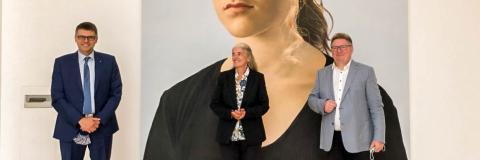
Afterwards, the Minister visited the Kurhaus Kleve Museum together with the university president. There, she was welcomed by the museum’s director, Professor Harald Kunde, and given a guided tour of the museum’s exhibitions. The guests were particularly impressed by the current exhibition by the internationally acclaimed artist and filmmaker John Akomfrah. The works are characterised by visually powerful explorations of post-colonialism and experiences relating to global migration – a topic with which the university has strong links.
The President highlighted the connection between academia and the arts, which is fostered not least through the ‘Science Meets Art’ events organised jointly by the museum and the university. “The benefits of the exchange between culture and academia are enormous. This connection creates a very special opportunity to approach contemporary issues from a wide variety of perspectives,” emphasised Minister Pfeiffer-Poensgen.