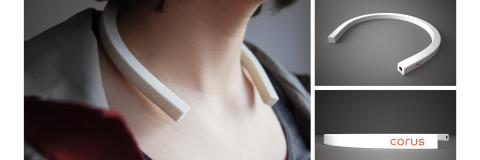
Kleve/Kamp-Lintfort, 2 May 2016: In his final-year dissertation, student Apiwat Anuntrachartwong explored the question of how music can be made tangible for people with physical impairments affecting their hearing. This resulted in an extraordinary Bachelor’s thesis entitled ‘Corus’. With ‘Corus’, Apiwat Anuntrachartwong aims to bring music closer to deaf or hard-of-hearing people through vibrations, by having them wear a neckband. The acoustic signals of the music are transformed into different forms of vibration via the neckband, with each component of the sound receiving a specific tactile signal. The experience is comparable to feeling the deep bass notes of music or the vibrations of a loudspeaker.
The underlying premise here is that the emotional aspects of music can be conveyed in different ways. The various frequencies detected by the skin trigger different emotions. “Corus exemplifies the power that can arise from the combination of design and research. Here, design is understood as an integral part of product development that can spur innovation processes. This makes Apiwat’s project an outstanding piece of work,” says his supervisor, Prof. Christoph Zielke, Professor of Media Design at Rhein-Waal University of Applied Sciences.
As part of this Bachelor’s thesis, Apiwat Anuntrachartwong developed the name, the corporate identity, the basic concept for the product design, the packaging design and a brochure. The resulting concept and the design elements from the Bachelor’s thesis have now been recognised by the ADC. This is one of the most prestigious awards in the creative industry for work that sets new standards in its category. Apiwat Anuntrachartwong drew inspiration for his work from research carried out at Ryerson University in Toronto. There, a chair was developed based on the principle of transforming acoustic signals into vibrations.