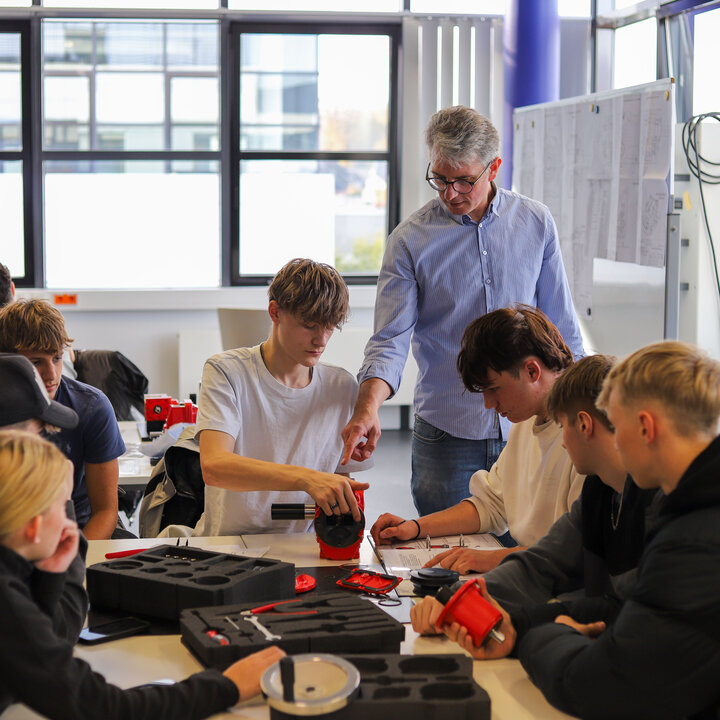
In the 2025/26 winter semester, four newly developed, practice-oriented Bachelor’s degree programmes will be launched at Rhein-Waal University of Applied Sciences (HSRW). The English-taught Engineering for Sustainability (B.Sc.) programme stands out in particular, as HSRW is adopting a completely new approach here: a project-based course that actively involves students in real-world challenges from the very first semester. Instead of traditional lectures, students work on interdisciplinary projects that combine technology and sustainability. Flexible modules enable students to choose their own areas of focus and thus tailor their course to their interests and career goals. “You can think of the programme like this: there are no lectures; instead, there are so-called centres where professors work together with students on specific topics. The students all learn together in centres of excellence, similar to departments within a company. In these centres, they take on different roles and learn from one another,” explains Prof. Dr.-Ing. Peter Kisters, Vice-President for Research, Innovation and Knowledge Transfer, outlining the innovative concept.
The focus: individual learning pathways
In the first semester, students complete a series of modules that build on one another to prepare them for the main course of study. Here, they become familiar with working in laboratories, develop their social skills and gain experience in project work through their first group project. From the second semester onwards, the programme takes the form of projects that grow in scale as the semesters progress. Depending on the semester, students work together on a project for up to seven weeks, deepening their knowledge and specialising in a particular area. The projects are selected from nine ‘Centres of Knowledge’.
“We deliberately avoid providing highly detailed and intensively specialised subject knowledge, because it is far more important that students know how they can acquire this specialist knowledge sooner or later,” says Prof. Dr.-Ing. Peter Kisters. “They should be able to acquire exactly what they will ultimately need in five or ten years’ time to tackle the challenges they will then face in the workplace.”
Practical example: e-mobility platform
Since 2022, students have been actively engaged with real-world requirements in the Mechatronics and Control Engineering Laboratory. Separate from the teaching programme, the two research assistants, Dr.-Ing. Martin Hellwig and Michael Titze, have worked with students to convert a go-kart into a development platform for electric vehicles. Today’s vehicle bears little resemblance to the original pedal-powered vehicle designed for young people – much to the satisfaction of the pair. “The platform incorporates all the components of a modern electric car’s drive system: lithium-ion battery, CAN data bus, control units and electric motors,” explains Michael Titze as he demonstrates the individual components during a tour of the facility. The entire vehicle structure and most of the components were developed and built by the students themselves. What makes this unique is that all four wheels are driven electrically and independently of one another, and the torque can be distributed specifically to individual wheels. This enables the students to develop innovative driving functions such as torque vectoring and bring them to life.
“The go-kart is now in ideal condition: we have a platform to which versatile projects from a wide range of engineering disciplines – such as design planning, automation technology or modelling – can be linked. Everyone makes a positive contribution to its further development,” explains Martin Hellwig. “The modular structure, which is identical to that of an electric car, prevents parallel projects from conflicting and the vehicle’s functionality from being compromised.” It is the perfect setting for the projects that form the basis of the practical semesters in the Engineering for Sustainability BSc degree programme.
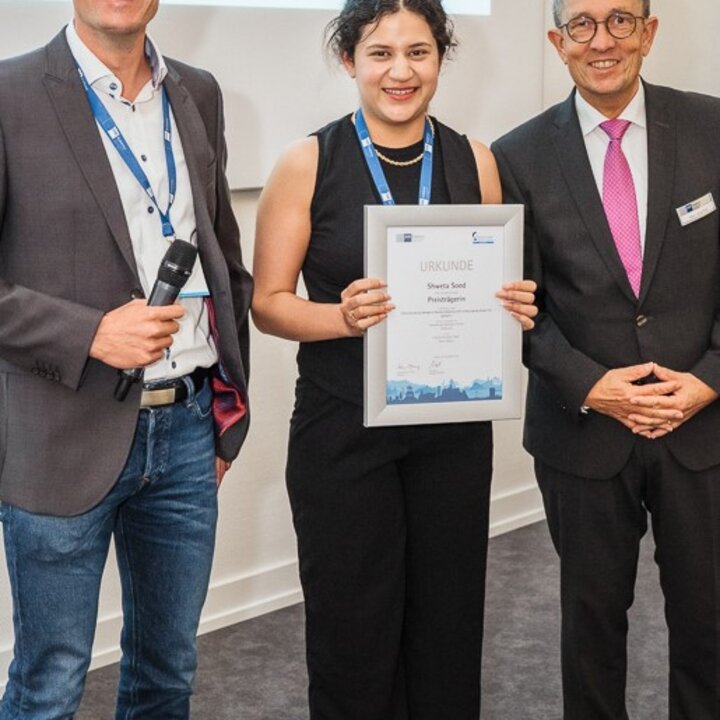
Martin Hellwig spends 50 per cent of his time as a research assistant at the Faculty of Technology and Bionics and the other half in the development department at Ipsen International GmbH. This year, he and Ipsen were jointly awarded the Higher Education Prize by the Kleve District Economic Development Agency. His work at the company also combines theory and practice in an ideal way. “I can engage extensively with the research topics at Ipsen and gain deep insights into the systems there, whilst at the same time maintaining constant contact with the university, exchanging ideas with my colleagues here and drawing on expertise in various fields. This means the ‘pathways’ for knowledge transfer are particularly short,” says Martin Hellwig. This is precisely what the organisers of the new ‘Engineering for Sustainability, B.Sc.’ degree programme have in mind. Incidentally, this degree programme follows a traditional structure: seven semesters, including a placement semester and a practice-oriented final dissertation, lead to a Bachelor of Science (B.Sc.).
Meet Team Gokart at the STEM Festival
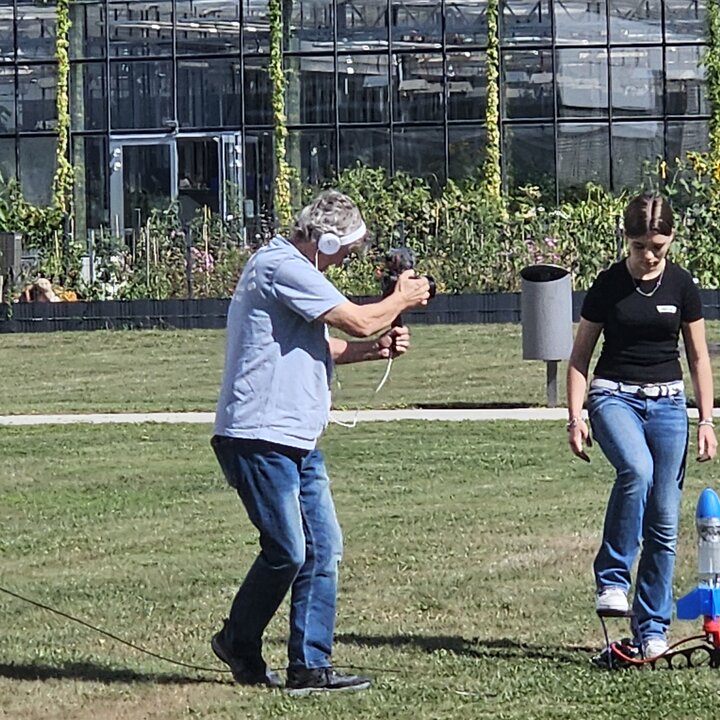
Incidentally, pupils in Years 9 to 12 at secondary schools in the districts of Kleve and Wesel will have the opportunity on 2 and 3 July 2025 to meet Team Gokart in person at the MINT Festival organised by the Faculty of Technology and Bionics. A varied programme is on offer to explore applied sciences in the STEM subjects of mathematics, computer science, natural sciences and technology. Whether experiencing projects and experiments first-hand or getting hands-on in practical workshops, the Faculty’s laboratories and lecture theatres will be open to the public during the MINT Festival. Registration must be made via the schools by 18 June 2025 at: zdi-kleve@hochschule-rhein-waal.de
Background
The innovative and practice-oriented BSc in Engineering for Sustainability programme will commence in the 2025/26 winter semester. Prospective students can apply or enrol online for Bachelor’s and Master’s degree programmes via the Rhein-Waal University of Applied Sciences’ application portal until 15 July 2025. The online portal can be accessed directly via the Rhein-Waal University of Applied Sciences’ homepage. There, applicants can also find further information on the interdisciplinary degree programmes. The Central Student Advisory Service (ZSB) is on hand to provide support and advice to anyone still looking for a suitable place on a degree programme or who has further questions about any of the degree programmes.