
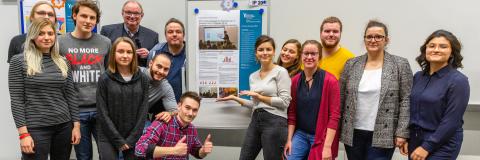
This year, too, a total of 23 project groups explored a wide variety of research topics and presented their findings at the annual poster session.
HSRW
Poster Award 2020
This year, too, a total of 23 project groups explored a wide variety of research topics and presented their findings at the annual poster session.
… and the winners are:
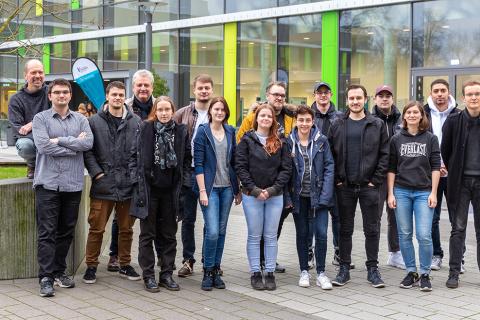
First place went to Benedikt Haaz, Louisa Stoffers, Svenja Meurer, Maximilian Iländer, Anatoliy Novohatniy, Niklas Meusel, Simon Holzhauer, Laura-Marie Behmenburg, Iris Schmidt, Patrick Holstein, Felix Groß, Sylvia Pfaffe, Nico Skubacz and Morad Ziati with their project poster on the topic ‘Monterburg – Historical Reconstruction of Monterburg and its History’. Under the supervision of Professor Dr Frank Zimmer, Professor of Computer Science and Mathematics, and Dr Frank Dießenbacher, Lecturer in Media Technology at Rhine-Waal University of Applied Sciences, the students from the Media Informatics degree programme produced a film that brings the history of Monterburg to life. To this end, they conducted interviews with local experts, presented the historical background in the form of a short dramatisation, and created an animated, abstract 3D reconstruction of Monterburg as it would have appeared in the 13th/14th century.
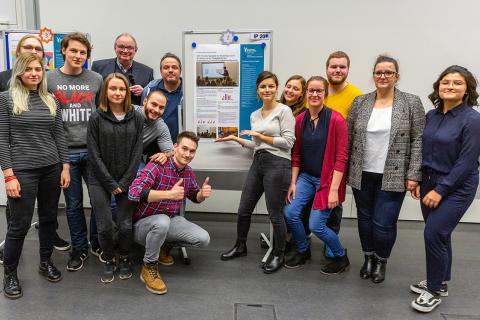
Second place went to Pascal Andres, Ronja Awater, Zuhal Cavus, Denyse Eitner, Linda Gatzke, Niclas Küppers, Tobias Meyer, Irene Moor, Agnesa Sahitaj, Marcel Schmidt, Judith Simon, Gianfranco Vela, Nils Winter, Sebastian Wittmann, Marius Zander and Philipp Zelle for their project poster ‘IT Security Awareness and Pedagogy in Raising Awareness of Digitalisation Risks’. Under the supervision of Professor Dr Ulrich Greveler, Professor of Applied Computer Science specialising in IT security, students from the Media Informatics, Psychology (Work and Organisational Psychology) and Administrative Informatics / E-Government programmes developed tailored materials on computing topics for children in Years 4 and 5. To this end, they visited several primary and secondary schools to deliver the relevant lessons in person. In addition, they developed training materials for adults on the topic of IT security, which were made available as a comprehensive package for free use.
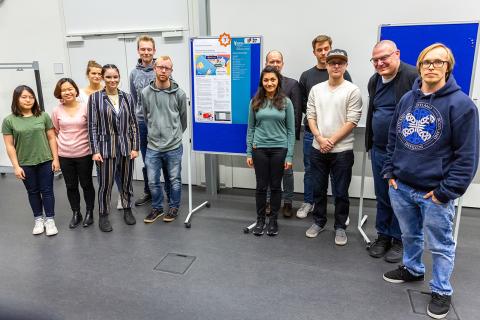
Third place went to Jennifer Berger, Huyen Tram Do, Jasper Elliger, Johannes Franzen, Joanna Ibsch, René Kunz, Maria de Los Angeles Salceda Kick, Jerod Mclean, Jens Ohlmann, Thuy Pham and Jan Schapdick. Their project, “The GameLet Games – Gamified, media-based training in reading fluency”, was developed under the supervision of Professor Dr.-Ing. Ido Iurgel, Professor of Media Informatics, and Professor Zimmer. As part of the international research project GameLet, students from the degree programmes in Media Informatics, Psychology (Industrial and Organisational Psychology), Mobility and Logistics, Communication and Information Engineering, and International Business Administration created, amongst other things, a game called ‘Corrector Cat’. In accordance with the project’s guidelines, this is a playful, media-based approach that is also intended to be used for further research within the project in the future. GameLet has set itself the aim of developing and promoting pupils’ reading skills in both their mother tongue and foreign languages.