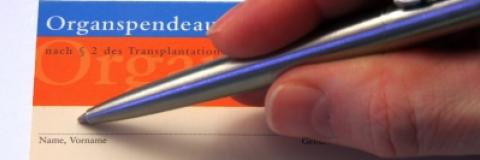
Kleve/Kamp-Lintfort, 29 April 2015: Organ donation and transplantation – issues that have repeatedly made the headlines across Germany in recent years – sometimes in a positive light, sometimes in a negative one. In the Lower Rhine region, too, these issues are more topical than ever. The Transplantation Act sets out a comprehensive and fundamentally positive stance on the part of society towards the issues of organ donation and transplantation. Every hospital, including those in our region, which has intensive care beds is obliged to identify potential organ donors and to maintain the necessary infrastructure for a possible donation. The new Act emphasises that the transplant coordinators appointed in every hospital play a central role in the process chain surrounding organ donation and, ultimately, on the path to transplantation.
Drawing on the responsibilities of transplant coordinators, Dr Gero Frings will explain the procedures involved in organ donation. Dr Frings will use the key role arising from the statutory mandate for transplant coordinators as an example to provide a clear picture of the development, structures and procedures involved in organ donation. He will also discuss quality assurance measures and the trend in the number of organ donations carried out up to 2015. There will be ample time for discussion and questions.
Dr Gero Frings is the transplant coordinator for organ donation at St Bernhard Hospital in Kamp-Lintfort, an institution of the Franziskus Foundation, Münster. During his years working at a large tertiary care hospital, Dr Frings has gained extensive experience in the field of brain death diagnosis and organ donation, which has led to his strong commitment to the cause of organ donation. Dr Frings is a co-founder and chair of the ‘Arbeitsgemeinschaft der Transplantationsbeauftragten in NRW e.V.’ (Working Group of Transplant Coordinators in North Rhine-Westphalia) and, in this capacity, sits on several committees and panels.
The lecture forms part of the Studium Generale programme. The lecture series is aimed at the general public, students, lecturers and staff at Rhine-Waal University of Applied Sciences, and presents current topics in a way that is relevant to everyday life and informative. The series also offers the opportunity to engage with current issues.
The lectures in the Studium Generale programme at Rhine-Waal University of Applied Sciences are free of charge for members of the public.