With around 500 animals, Kleve Zoo is one of the most beautiful places to visit in the region and is particularly committed to preserving biodiversity. To educate visitors about the animals, their behaviour and specific characteristics, and to spark an interest in the conservation of these species, zoological information boards were once again created this year by students from Rhine-Waal University of Applied Sciences.
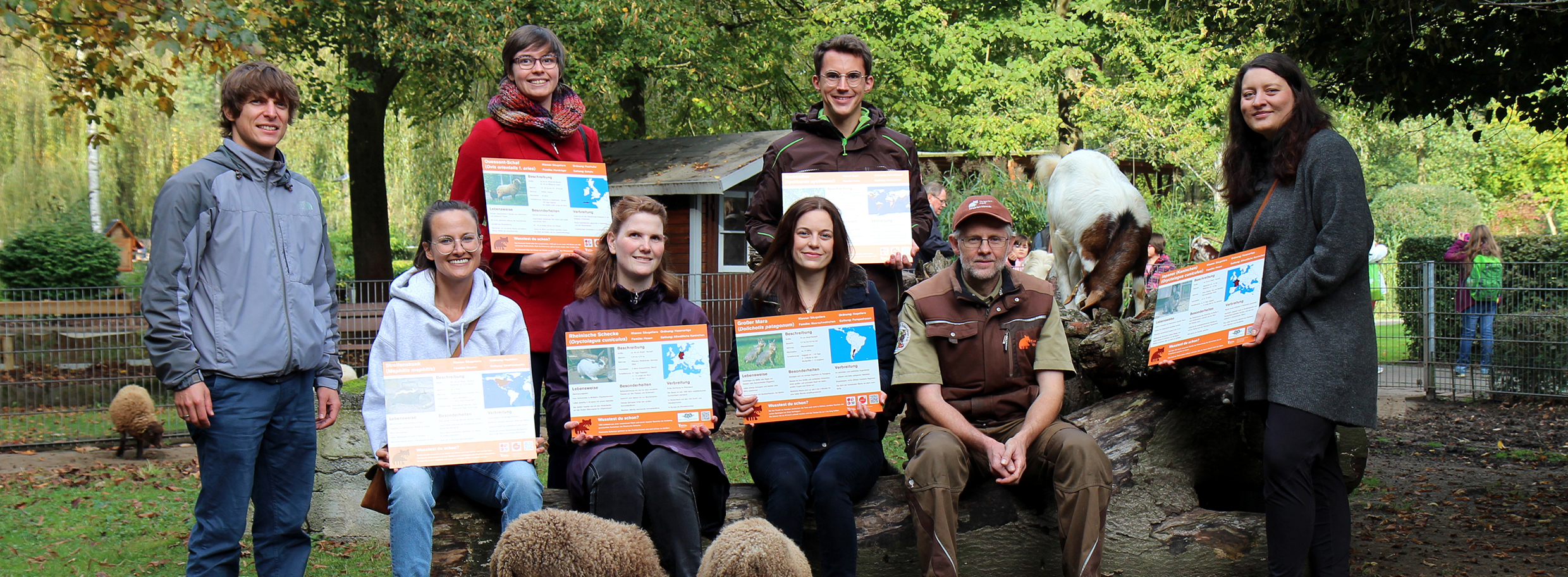
Thanks to the partnership between the university and the zoo, which has been in place since 2014, 36 signs featuring various animal species have already been designed and installed. This year, six more have been added: now that the project has been completed, visitors can also find detailed information on the night heron, striped skunk, Japanese rabbit, Rhenish spotted rabbit, Ouessant sheep and the greater mara on the new zoo signs. More detailed texts about the animals will be accessible via a QR code on the zoo’s website. To reach as wide an audience as possible, all the material is also available there as an audio file, narrated by radio presenter Norbert Hoffmann from Radio 91.2 Dortmund. In addition, the animal profiles will also be available in English and Dutch.
Under the supervision of Axel Huth and Ramona Kirsch from Rhein-Waal University of Applied Sciences, as well as zoo director Martin Polotzek, his deputy Christine Oster and his deputy Dietmar Cornelissen, students from the Faculty of Life Sciences took part in the project. In the process, they learnt the basics of scientific research as well as how to communicate specialist knowledge to a wider public. At the same time, particular emphasis was placed on teamwork and project management. They also worked with technical software: each participant used a vector graphics programme to create their sign.
Due to the COVID-19 situation, all the university’s meetings had to be held online. This presented the whole group with additional challenges, but these were overcome through the use of various technical and web-based solutions.
During a visit to the Tiergarten, the participants had the opportunity to see the animals. Photographer Lisa Hanke was also present; her photographs of the animals can be seen on the signs and on the website.
Everyone involved is delighted that the project has been successfully completed and hopes that the new signs will enhance the zoo experience for all visitors.