For the first time, students had the opportunity to take part in a virtual exchange semester, which was organised in collaboration with five different European partner universities:
- The Hague University of Applied Sciences (THUAS), the Netherlands
- Tampere University of Applied Sciences (TAMK), Finland
- Universidad Francisco de Vitoria (UFV), Spain
- Masaryk University (MUNI), the Czech Republic
- University of Cagliari (UNICA), Italy
There were five different modules to choose from: Intercultural Management, New Media and Entertainment, Functional Facility Design, Pathways to the Circular Economy, Participation, Collaboration and Teamwork, and the Future of Europe.
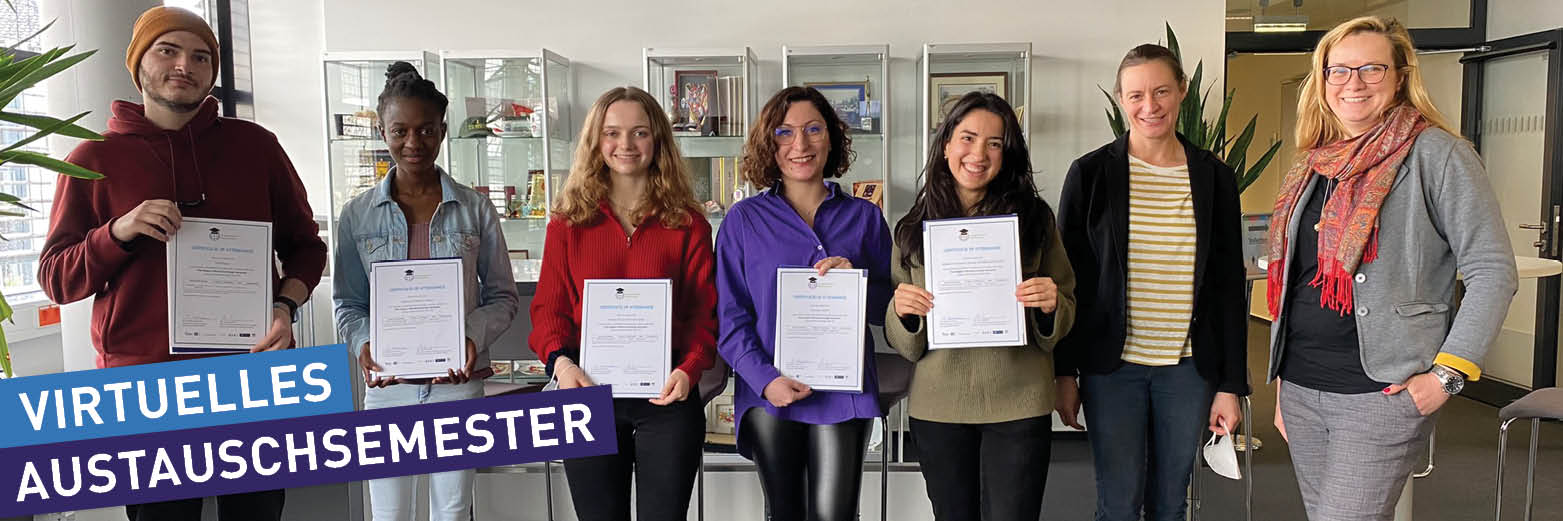
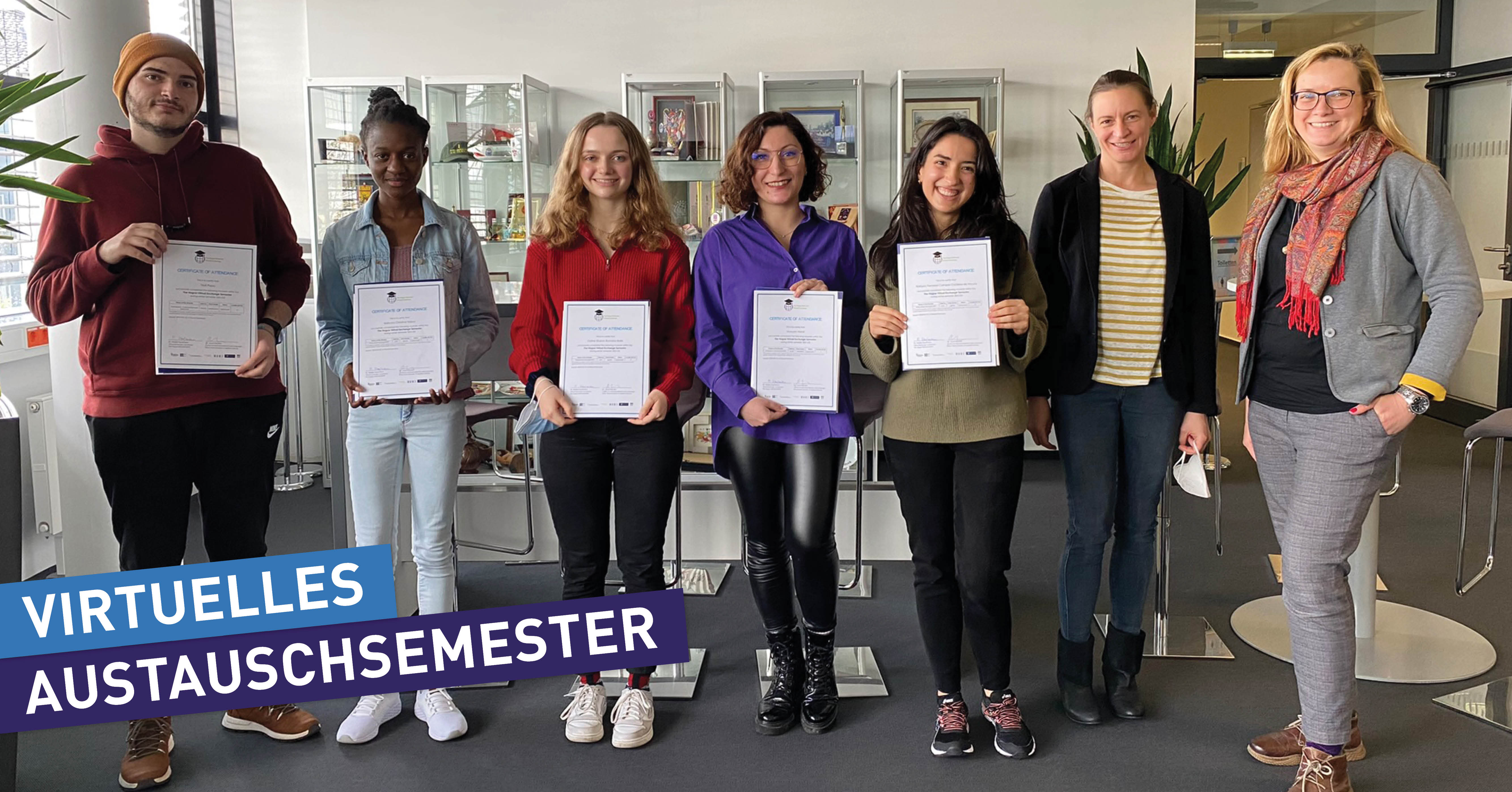
A total of 15 students from all four faculties at Rhein-Waal University of Applied Sciences successfully took part in the modules. On 7 April 2022, they were presented with their certificates of participation by the Vice-President for International Affairs and Diversity, Prof. Dr Tatiana Zimenkova, and the project coordinator at the Centre for Internationalisation and Languages (ZIS), Dr Maike Kaufmann.
The students had the opportunity to choose one or more modules from those on offer whilst studying at various partner universities in Finland, Spain, Italy, the Netherlands or the Czech Republic. This is what sets the project apart from traditional bilateral student exchange programmes. “Even before the coronavirus pandemic, a great deal of pioneering work had been done in the internationalisation of university cooperation to explore new avenues for virtual student exchange. In future, we want to use such initiatives to reach those students who might otherwise be reluctant or unable to go abroad. For example, because of personal circumstances that make this difficult, or to offer our international students a further opportunity to gain international experience,” explains Maike Kaufmann.
A major challenge is organising the international programmes offered by several partner universities. “Whilst even in standard bilateral exchanges of students, lecturers and staff between universities, a great deal of time and energy must be invested in overcoming legal, administrative, practical and intercultural hurdles, this takes on a completely different dynamic in a multilateral project. Every country and every partner university has its own teaching methods, administrative procedures and organisational structures, all of which need to be co-ordinated with one another. Our students also have to put in a fair bit of effort, as it involves extra organisational work for them. In return, however, they gain a particularly international perspective on their field of study,” the ZIS member continued.
Feedback from the students reflects this. For many, the organisational aspects did pose a particular challenge, as they had to register on a wide variety of learning platforms at each university.
“Despite initial difficulties with registering at the partner universities and accessing the lectures, it was well worth it,” emphasises student Celine Balle, “In my International Relations degree programme, we also study Intercultural Management; however, the module at our Spanish partner university was structured quite differently and offered a different perspective and approach to the subject of Intercultural Management. That was very interesting for me and my fellow students.”
For Pepo Tedi, it was important to explore the topics of collaboration and teamwork: “I’m studying for an engineering degree. It was therefore important for me to learn a bit more about collaboration and teamwork, as this will be crucial later on when carrying out engineering projects. In that respect, the course gave me the opportunity to gain new insights.”