To help shape the Lower Rhine region in a sustainable way through exchange, applied research, pilot projects and capacity building – that is the aim of the project ‘Transformation of the Lower Rhine Region – Innovation, Sustainability, Participation’, or TransRegINT for short. Within the first year, over 20 staff members were recruited, research projects were launched, the first collaborations in the region were established and events were organised.
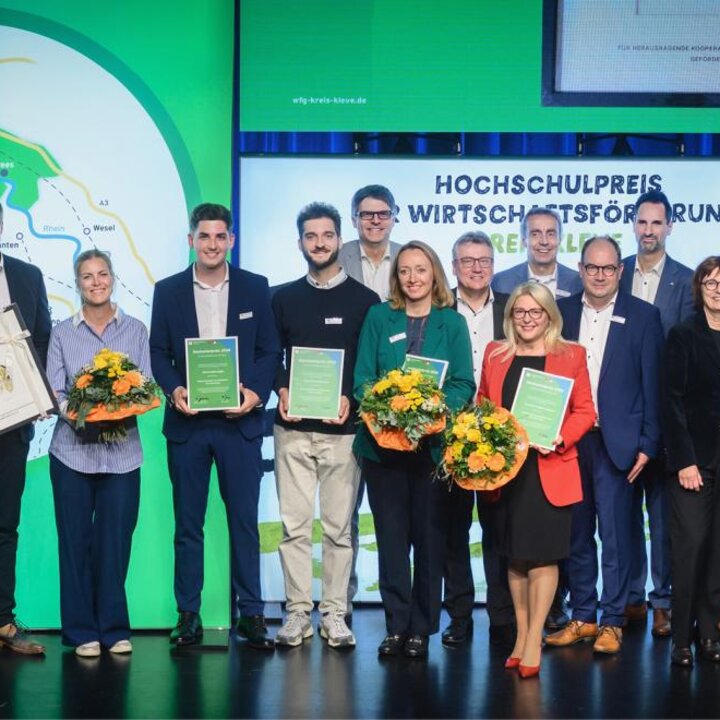
TransRegINT was officially launched on 1 March 2023. Two months later, with the first colleagues on board, the kick-off event took place at Moyland Castle. The next key events followed in September and October: the ‘Klever Birne’ and the ‘ZukunftsLab Niederrhein 2023’. The ‘Klever Birne’, an ideas competition on sustainability in and around Kleve, attracted more than 20 entries. On 14 September 2023, four different ideas were recognised for having impressed the jury and the audience, including a training farm initiated by local residents and a climate café. The ZukunftsLab Niederrhein 2023 also aimed to develop creative solutions to the Lower Rhine region’s current challenges. To this end, partners and stakeholders from the region, as well as from academia, politics, business and civil society, came together. The results of the first Lower Rhine Future Lab continue to bear fruit: individual ideas and concepts are being compiled and pursued as part of TransRegINT.
The first year was devoted in particular to building up the team. The project now comprises over 35 people, including its own staff and supervising professors. Half of the TransRegINT team works on transformation projects: Here, research is being conducted into future-oriented topics to develop science-based solutions for the Lower Rhine of tomorrow – entirely in keeping with the motto ‘Better to change things yourself than to be changed’, says Prof. Dr.-Ing. Peter Kisters, Vice-President for Research, Innovation and Knowledge Transfer, who is also the project leader.
Last year, the focus was particularly on collaborations with industry partners and students. Partnerships with local stakeholders are essential for driving sustainable change in the Lower Rhine region. The TransRegINT network is growing steadily, and new discussions, networking events and collaborations are constantly taking place within the individual transformation projects. For example, the LabLandschaften team organises business networking evenings. The Agroforestry Real-World Laboratory team organises workshops with farmers to establish partnerships in the region. Students are also involved, for example in an interdisciplinary project to build a fuel cell as part of the ‘Hydrogen in the Lower Rhine’ project. To embed the project results sustainably and share knowledge, a ‘Transformation Academy’ is also to be established, in close collaboration with visiting professors.
Following the successful establishment of the project structures in the first year, the focus in the second year of the project is on deepening collaboration with regional partners. Further events are also already planned, such as the second round of the ‘Klever Birne’ ideas competition.
Background
TransRegINT stands for ‘Transformation of the Lower Rhine Region – Innovation, Sustainability and Participation’. Through this project, Rhine-Waal University of Applied Sciences has set itself the goal of helping to shape the future of the Lower Rhine region in a sustainable and science-based manner. The project is receiving just under 10 million euros in funding from January 2023 to December 2027 as part of the ‘Innovative University’ funding initiative of the Federal Ministry of Education and Research. The funding initiative supports universities in translating research findings even more effectively into creative solutions for the pressing challenges of our time. In doing so, Rhine-Waal University of Applied Sciences (HSRW) is guided by the United Nations’ 17 Sustainable Development Goals.
Contact
Christina Martens
, Coordinator of the Interaction Hub, TransRegINT
Centre for Research, Innovation and Transfer
Tel.: +49 2821 80673 9637
Email: christina.martens@hochschule-rhein-waal.de