
As part of a working visit, the Dutch Consul-General, Ton Lansink, visited Rhein-Waal University of Applied Sciences in Kleve.
HSRW
Consul-General pays a working visit to the Euregio Rhine-Waal
As part of a working visit, the Dutch Consul-General, Ton Lansink, visited Rhein-Waal University of Applied Sciences in Kleve.
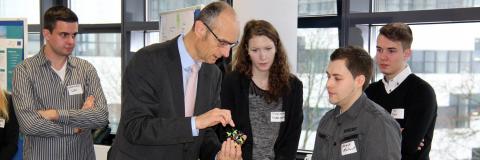
As part of his working visit, Consul-General Ton Lansink was a guest at Rhine-Waal University of Applied Sciences on the Kleve campus. There, the Consul-General held discussions with the President, Dr Heide Naderer, lecturers, staff and students from Germany and the Netherlands about Rhine-Waal University of Applied Sciences, as well as the INTERREG projects “Krachtige Kernen” (Strong Villages – Improving the Quality of Life in Villages and Rural Areas) and “Spectors” (Development of New Applications for Drones). The Consul-General followed the project groups’ presentations with great interest. Of particular interest was the demonstration of a drone used for surveying, structural inspections, film production, agriculture and other Earth observation applications.
Following his visit to Rhine-Waal University of Applied Sciences, the Consul-General continued his working visit to the fire station in Millingen aan de Rijn. The fire services of Millingen and Rindern work closely together as part of the INTERREG project ‘Security without Borders’.
The working visit took place as part of the closing conference of the Cross-Border Economy and Labour Action Team.
The action team was established in the Netherlands at the end of 2015 as the ‘Actieteam Grensoverschrijdende Economie en Arbeid’. Within the Action Team, politicians and experts from the border municipalities and provinces, the Vereeniging Nederlandse Gemeenten, the Euregios, MKB Nederland and government authorities work closely together. The Euregio Rhine-Waal participates in the Action Team on behalf of all Euregios. The Action Team’s main objectives are to raise awareness of the opportunities and possibilities beyond the border and to reduce border barriers as much as possible. The Action Team has set out its approach in a final report and a catalogue of measures. These two documents also describe a wide range of good examples of cross-border projects from all border regions. Both documents were presented yesterday to government representatives from the Netherlands, North Rhine-Westphalia, Lower Saxony and Flanders during a cross-border conference at De Vereeniging in Nijmegen.