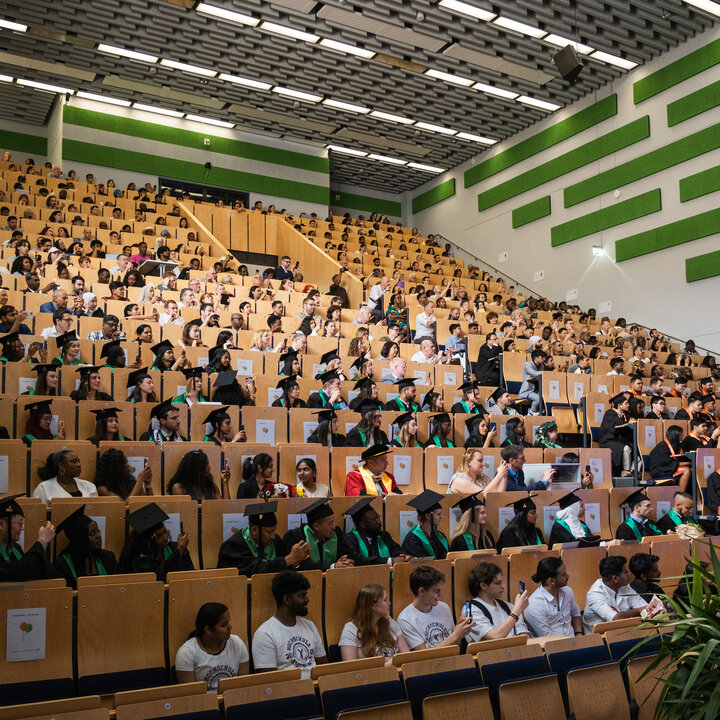
For the first time, District Administrator Christoph Gerwers welcomed the guests in his capacity as patron of the event. The District Administrator expressed his delight that the event had lost none of its appeal since 2007. In particular, Gerwers said, the Kleve District Forum was also about “celebrating the fruitful collaboration between the university and the regional business community”. Once again this year, the district’s economic development agency received numerous applications for the University Award, from which the jury – comprising the District Administrator, representatives of the local savings banks and cooperative banks, the district’s economic development officer, Brigitte Janssen, and the university’s president, Prof. Dr Oliver Locker-Grütjen – ultimately selected three winners. “What unites you all is that you recognised long ago the added value that Rhein-Waal University of Applied Sciences brings to entrepreneurs in our region. For you have sought contact with the university in the hope of finding a solution to your problems here. And you were not disappointed,” said Gerwers. The projects submitted clearly demonstrated that the university had kept its promise to deliver knowledge transfer to the region.
Before the university awards ceremony began, the evening’s keynote speaker, Prof. Dr Uwe Peter Kanning, addressed the guests on a topic that is currently a pressing concern for many entrepreneurs: the search for suitable staff. To illustrate just how many things can go wrong in this process, the economist had deliberately chosen a provocative title for his talk: ‘How to guarantee you find the wrong employee’. Using twelve examples, Prof. Dr Kanning entertained the guests whilst clearly explaining, on the one hand, what companies should avoid during selection processes, and, on the other, how successful recruitment works. One key insight was that HR professionals should not rely solely on their judgement of character and gut instinct. Otherwise, they might “fall for charlatans like Gerd Postel, who used lies and deception to swindle his way into jobs ranging from postman to senior consultant and psychiatrist”, said Prof. Dr Kanning with a smile. The lecture was very well received and was rewarded with a long round of applause from the audience.
This was followed by the eagerly awaited presentation of the 2023 University Awards, supported and sponsored by the Sparkassen and Volksbanken in the district of Kleve. The first university prize went to Emmerich am Rhein. The award was presented to Biotec GmbH & Co KG and the Chair of Non-Metallic Materials at the Faculty of Technology and Bionics, headed by Prof. Dr Christoph Heß. The Biotec team, led by Managing Director Stefan Barot, produces biodegradable composite plastics that can be used to manufacture products such as frozen food packaging or carrier bags. In a joint project with Prof. Dr Christoph Heß’s Chair, small quantities of these plastics are fermented together with large quantities of biomass. This process is intended to produce biogas that can be used to generate energy. The initial results are promising.
The second university prize for 2023 went to Fluxana GmbH & Co. KG from Bedburg-Hau and the Chair of Technical Informatics at the Faculty of Technology and Bionics, held by Prof. Dr Ronny Hartanto. Since the founding of Rhein-Waal University of Applied Sciences, Fluxana has been committed to close collaboration, having supervised 16 working students, facilitated eleven compulsory work placements, supported six Bachelor’s theses and even recruited three graduates from Rhein-Waal University of Applied Sciences. The project, which has now been honoured with the university prize, focuses on the automation of sample preparation machines for X-ray fluorescence analysis. It utilises artificial intelligence and robots that weigh and transport the samples with pinpoint accuracy.
The third-place winner is the City of Kleve’s Environmental Services (USK) and Prof. Dr Matthias Kleinke and Prof. Dr Florian Wichern from the Faculty of Life Sciences. USK has invested in a thermal compaction plant at the Kleve-Salmorth sewage treatment works, thereby laying a crucial foundation for the transition to an energy-self-sufficient and thus climate-neutral sewage treatment plant. The planned expansion of this thermal compaction plant is intended to contribute to optimisation in terms of energy efficiency, economic viability and environmental sustainability. The project, which has been awarded the university prize, focuses on the recovery of sewage sludge using a pyrolysis process that produces high-quality phosphate fertiliser in the form of charcoal. Trials are being carried out in the university’s greenhouse to determine how effectively certain plants absorb the nutrients contained in the pyrolysis charcoal and what crop yields can be achieved as a result. “This joint project is intended, so to speak, to demonstrate that the pyrolysis charcoal produced in Salmorth – the ‘black gold’ – can be put to good use in agriculture or horticulture to support and accelerate plant growth,” said District Administrator Gerwers in his laudatory speech.
Following the grand finale, with all the university prize-winners, the District Administrator, the jury and the presenter on stage, the guests gathered in the Kastell foyer for some lively conversation, taking the opportunity to look back on another successful ‘Forum Kreis Kleve’.