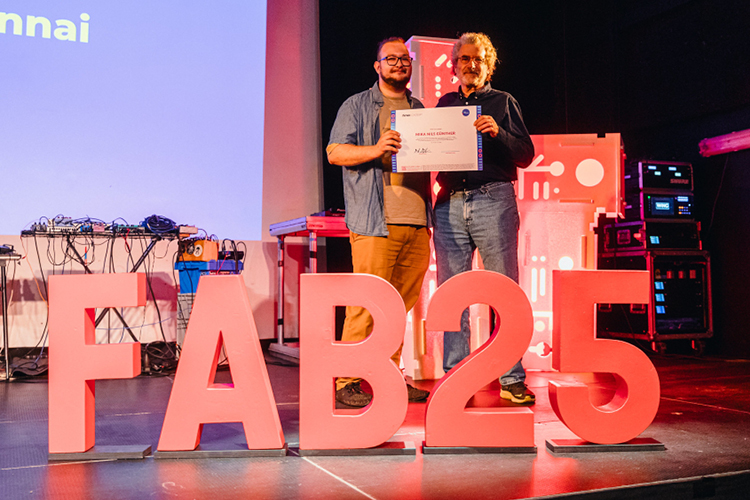
In January 2025, students Leen Skaf, Lysander Trapp and Mika Günther began the six-month programme at the international Fab Academy. Upon successful completion, they were invited to the global FabX 2025 conference in Prague and Brno, where MIT professor Neil Gershenfeld personally presented them with their Fab Academy diplomas.
Under the motto ‘How to make (almost) anything’, Gershenfeld – founder of the Fab Lab movement and professor at the Massachusetts Institute of Technology (MIT) – leads this internationally recognised training programme in the field of digital fabrication. The interactive lectures are broadcast live from MIT to locations including the FabLab in Kamp-Lintfort. A virtual campus connects students worldwide and enables collaborative project work across more than 60 FabLabs.
“The basic idea behind the Fab Academy is to teach you how to make things and to show that absolutely anyone can bring designs and projects to life. It pushed me to my limits whilst also helping me to discover new areas of knowledge that I already had up my sleeve,” reports Lysander Trapp.
As is the case every year, hundreds of participants worldwide – from makers to students and professors – took part in the programme, including the three students from Rhein-Waal University of Applied Sciences. At the FabLab in Kamp-Lintfort, they first developed their projects using CAD software and then brought them to life using CNC milling machines, 3D printers and laser cutters. They also designed and manufactured the necessary electronics themselves.
“What impressed me most was the international community and the interaction with the other participants. I particularly enjoyed being able to gain a lot of practical experience during the Fab Academy,” says Leen Skaf. The so-called ‘Wildcard Week’ proved particularly creative, as it allowed participants to freely realise their own ideas – provided they were related to digital fabrication. “My favourite was Wildcard Week, when we could do whatever we wanted,” adds Mika Günther. “I combined 3D printing with textile design by taking a piece of fabric and printing directly onto it.”
Upon successfully completing the course, the students received an invitation to the international Fab25 Czechia conference. As well as the formal certificate presentation ceremony, the event offered numerous networking opportunities and specialist workshops. A particular highlight was ‘Prusa Day’, featuring an exclusive tour of the Prusa Factory – Europe’s best-known manufacturer of 3D printers.
Prof. Dr Neil A. Gershenfeld is Director of the Centre for Bits and Atoms at MIT and is regarded as the spiritual father of the maker movement. His research focuses, amongst other things, on quantum computing, nanotechnology and personal fabrication. He has received numerous awards, including being named one of the ‘Scientific American 50’ (2004) and one of the ‘100 most influential intellectuals’ by Prospect magazine.
Rhein-Waal University of Applied Sciences has been participating in the Fab Academy since 2017 – the first university in Germany to do so. The practice-oriented programme has been offered worldwide since 2009 and has now been successfully completed by almost 40 students, staff and lecturers from Rhein-Waal University of Applied Sciences.