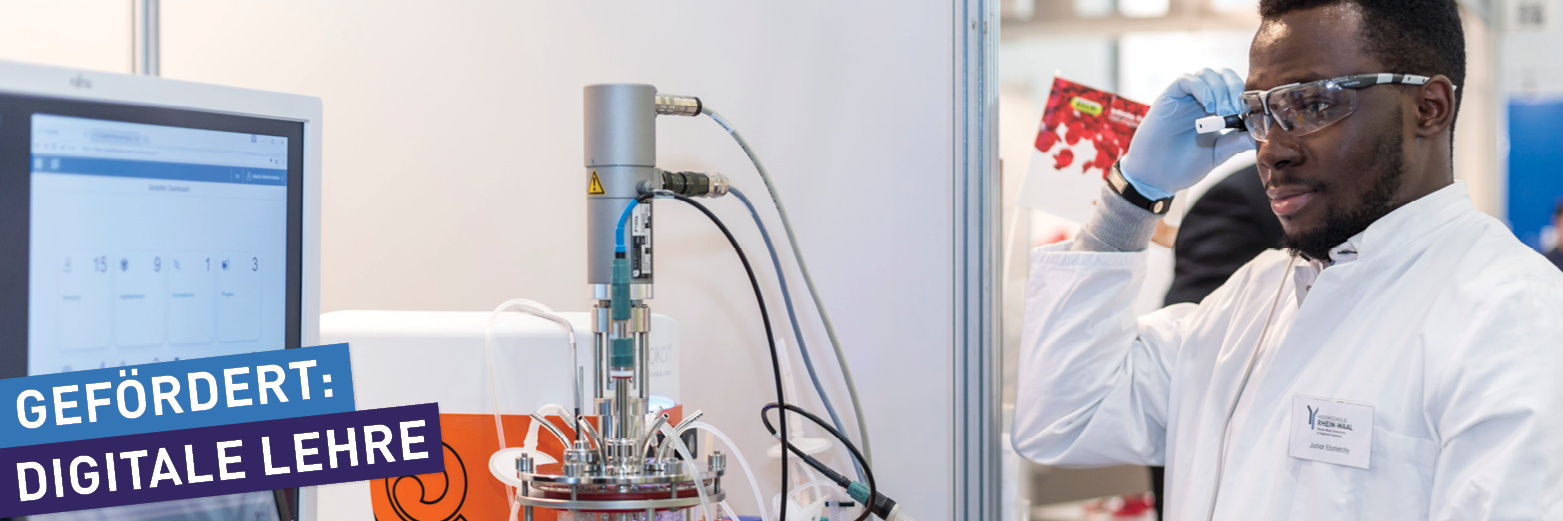
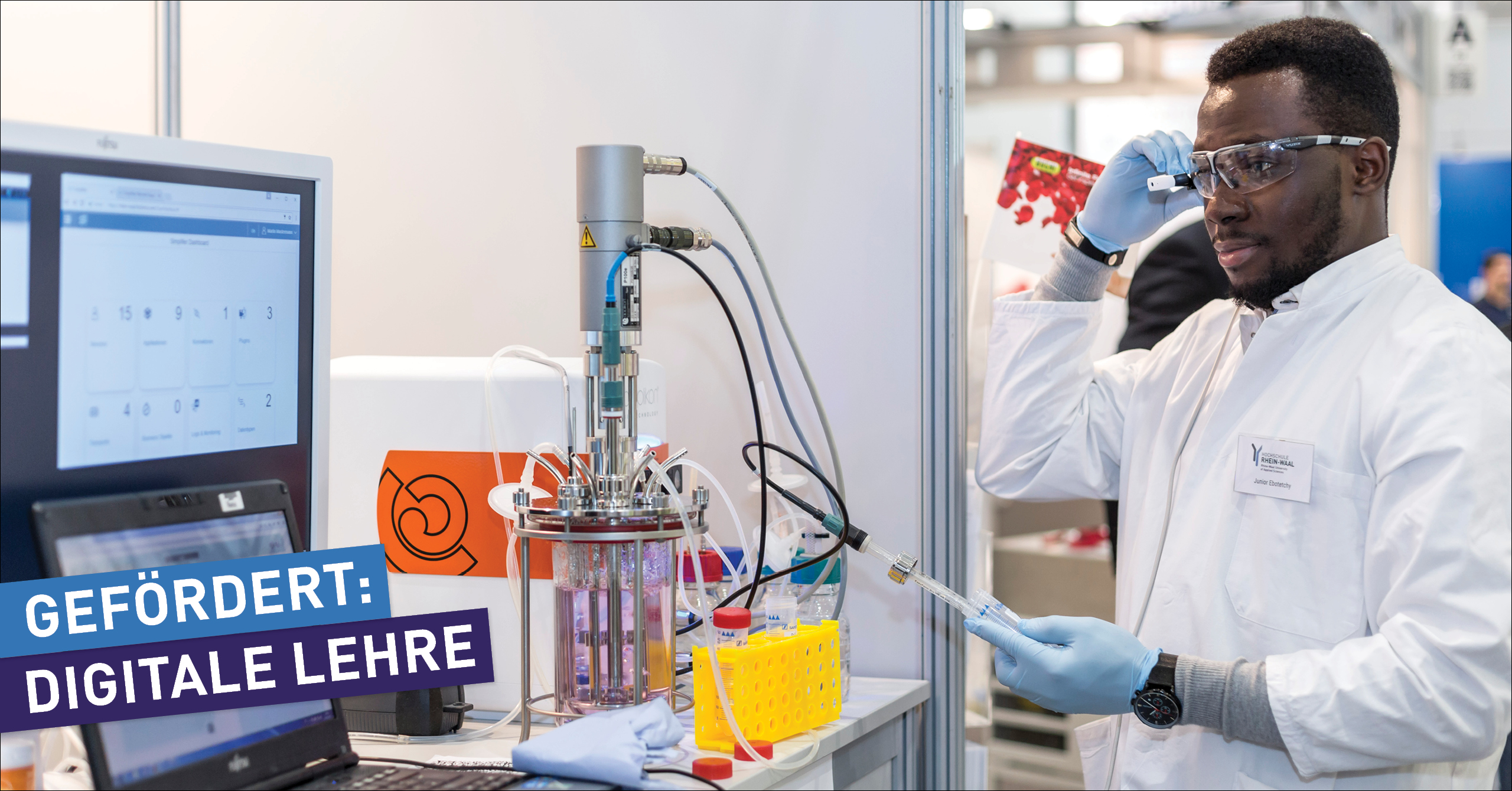
 ‘SmartLabOER’, ‘BioLabSim’ and ‘Bio-Jupyter’ – names that sound almost like computer games are, in fact, ways of sustainably improving practical training. In collaboration with Cologne University of Applied Sciences and Aachen University of Applied Sciences, Rhine-Waal University of Applied Sciences will, over the next two years as part of the ‘SmartLabOER’ project, create multimedia, interactive real-time tutorials as part of the ‘SmartLabOER’ project, which will provide students with close guidance throughout their practical training – and the whole system will be platform-independent, so that ultimately all universities of applied sciences in North Rhine-Westphalia can benefit from it. The state is providing 489,085 euros for the development as part of the ‘OERContent.nrw’ initiative.
Project manager Joachim Fensterle explains: “It wasn’t just during the period of distance learning that we asked ourselves: how can we organise these vital practical laboratory sessions for students even without the close contact that would ideally be desirable? With these tutorials, we will in future be able to guide beginners closely through the experiments, whilst also offering advanced students an open-access approach. As it is impossible to provide every student with a supervisor, this improves student support even beyond the pandemic situation,” says Fensterle, who is also the university’s e-learning officer.
With ‘Bio LabSim’, students will in future be optimally prepared for their work in the laboratory: Under the leadership of RWTH Aachen University, in collaboration with Westphalian University of Applied Sciences and Rhine-Waal University of Applied Sciences – represented by Prof. Dr Joachim Fensterle and Prof. Dr-Ing Sylvia Moenickes – the three biotechnology departments are developing personalised and interactive worksheets. These enable various stages of experimental projects to be simulated. The simulations not only ensure better preparation for and follow-up on practical sessions, but also promote digital literacy in handling complex biotechnological data – something that is now more essential than ever. Funding of 405,299 euros has been made available for this purpose as part of the ‘OERContent.nrw’ initiative, with effect from 1 April 2022.
The ‘small’ externally funded project ‘Bio-Jupyter’, which Professor Fensterle has secured as project leader together with Prof. Dr.-Ing. Sylvia Moenickes, Prof. Dr Björn Neu and Prof. Dr-Ing Frank Platte, ensures optimal integration into the ‘Bioengineering’ degree programme, alongside the ‘Digi-Fellow’ project led by Prof. Dr Rolf Becker, thanks to funding of 88,000 euros. The new support services can also be utilised through the purchase of laptops and the creation of the necessary storage systems, known as ‘clouds’.
Background: ‘OERContent.
nrw’ is the largest nationwide funding programme for open educational resources. Once the respective projects have been completed, the e-learning resources must be uploaded to the state portal for study and teaching, ‘ORCA.nrw’ (Open Resources Campus NRW). Here, teaching staff can share open educational resources with one another, and students can use them for self-study. All full-time, independent lecturers at state-funded art and music colleges, universities and universities of applied sciences under the auspices of the State of North Rhine-Westphalia are eligible to apply. The funding period is a maximum of two years. Further information: www.mkw.nrw/presse/oer, Source: Ministry of Culture and Science of North Rhine-Westphalia