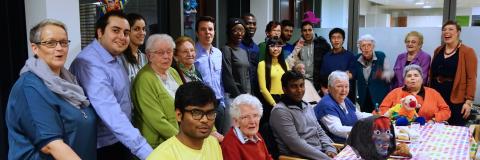
Everything about her is delicate, reserved and quiet. Anh Nguyen Minh Mai, aged 26, has just completed her first semester at the Rhine-Waal University of Applied Sciences in Kleve and speaks very little German. You can tell from her expression that she needs all her courage to set foot in the Herz-Jesu-Kloster care home on Hagschen Poort in Kleve. But the shy Vietnamese woman does just that. All on her own. And she is immediately given a warm welcome by the centre’s manager, Susanne Lamers. She is the first guest this evening, which marks the tenth time this event has taken place. And she is someone very special. For this is the monthly ‘Having a Grand-Friend’ meet-up, which the tutors at the Welcome Centre at the HRW have organised in collaboration with the Herz-Jesu-Kloster care home for the elderly. A meet-up designed to bring together young and old, and to foster encounters between cultures and religions.
Julia Ilg, head of the Welcome Centre, and tutor David Duque are fulfilling many of the students’ wishes through the ‘Grand-Friend’ initiative. After all, more than 100 nationalities come together at Rhein-Waal University of Applied Sciences, far from their families and home countries. “The common language is English. German often gets neglected – the students want more opportunities to speak German and engage in cultural exchange,” explain Duque and Ilg. And spending time with the senior citizens also helps to ease homesickness every now and then.
But back to Anh: she doesn’t stay on her own for long. More students arrive and senior citizens join them. Take 88-year-old Maria Boßmann, for example. The sprightly elderly lady sits down next to Anh; they introduce themselves with a handshake and immediately find something to talk about. This is because Boßmann’s daughter once lived in Vietnam herself for 4.5 years, and straight away a common ground is found between old and young, Catholic and Buddhist, the Lower Rhine and Vietnam. Despite significant language barriers.
Speaking of barriers: “There are hardly any – in fact, none at all. At least not of a cultural or religious nature,” says Monika van Uffelt, who oversees the project as a daily support worker from the senior citizens’ centre. “Most of the time, the students tend to be rather reserved at the Grand Friends evenings, whilst the elderly ladies have hardly any reservations about approaching the young people.” And they prove to be quite articulate in conversation with the young students. For example, when an Indian student explains that the cultural difference is very significant for him, a senior resident replies: “I can certainly understand that. I’ve been through it myself. You wouldn’t believe the culture shock I had to cope with when I came here to Kleve from my home country.” Incidentally, before moving into the care home, the elderly lady lived in a suburb of Kleve.
Cultural differences are particularly evident at the moment, during the carnival season, as the Egyptian Mohammed Bassiouny admits. He speaks German remarkably well and is smiling warmly at everyone the whole time. This is probably also because tonight’s topic, ‘Carnival’, particularly interests – and amuses – him. “We don’t have that in my home country. We don’t dress up there. It’s all very foreign to me. But it’s a bit mad,” he admits, smiling warmly at the admittedly rather ugly Möhnen mask on the table.
Seventy-five-year-old Christa van Appeldorn enjoys sitting next to Prasanna Kumar Sakhinel and laughs a lot with him. The fact that the Indian Hindu is unfamiliar with church visits – the sort that van Appeldorn still makes regularly to the chapel – makes this encounter all the more interesting. Meanwhile, pensioner Maria Dercks and Pavithran Boopathy have also greeted each other with a handshake and are listening together to a prepared interactive talk on the ‘Carnival of Cultures’. Only Elisabeth Haas notices a slight faux pas regarding the sweet treats, which were provided by the DAAD (German Academic Exchange Service): “Well, these here are Berliner. They’re delicious too,” Haas admits with a mischievous smile. “But at carnival time, Bolle Beuskes are the ones that belong on the table.” None of the students here from Indonesia, Egypt, Turkey, Vietnam, India and Colombia have tried them yet – but there’ll be plenty of time for that at the next meeting.