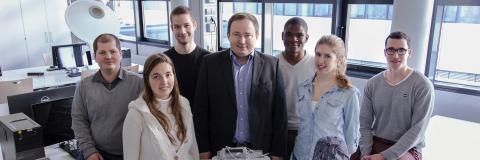
Kleve/Kamp-Lintfort, 22 March 2016: The project aims to develop new, innovative communication technologies which, with the help of so-called brain-computer interface (BCI) technologies, can make everyday life easier for people with physical disabilities and thereby improve their quality of life. BCIs form a direct interface between the human brain and the computer. Brain activity is measured using an EEG (electroencephalogram) and converted into control signals in real time by BCI software. In this way, even people with physical disabilities are able to operate a computer. The research project aims to provide affected patients with technologies that can be easily integrated into their everyday lives.
Advances in signal processing mean that even users who were previously unable to operate such a system can now benefit from this technology. Thanks to this development, it is now possible to move from the previous laboratory prototype to BCI technologies that can be used anywhere.
In developing these new technologies, the team of researchers is drawing on the insights gained from previous projects. “As we continue to develop this technology, we are planning a whole series of tests in collaboration with a care home for the elderly, so that we can integrate the BCI technology as effectively as possible into the everyday lives of the patients concerned. With this project, we aim to contribute to better healthcare provision in the home environment,” explains project leader Prof. Volosyak.
The research project is funded by the European Regional Development Fund (ERDF) as part of the ‘Health’ lead market competition. Rhine-Waal University of Applied Sciences is receiving €572,313 in funding.