

Would you like to combine technology with environmental awareness? Would you like to work on projects in laboratories right from your first semester? Can you do without traditional lectures and seminars? Then you’ve come to the right place! This degree programme will prepare you for careers in sustainable product development, environmental technologies or international projects. It is aimed at anyone who wants to approach engineering in a holistic and forward-looking way.
At a glance
Bachelor of Science
Full-time
7 semesters
Restricted
Kleve
English
1 September
Why study Engineering for Sustainability, B.Sc. at Rhine-Waal?


The forward-looking engineering degree programme with a focus on sustainability


Programme structure and content
With this degree programme, you’ll have opportunities in fields such as sustainable product development, environmental technologies, and, of course, international projects. Academically, this programme is grounded in modern mechanical engineering but is always closely linked to the concept of sustainability. So you’ll likely not enter a traditional mechanical engineering career, but rather pursue careers that focus specifically on innovation, future-readiness, and, of course, sustainability.
In this programme, we are fully committed to project-based learning. You’ll start right away in your first semester with several small projects to get acquainted with this unique approach to learning and studying, and you’ll receive close guidance from your mentor.
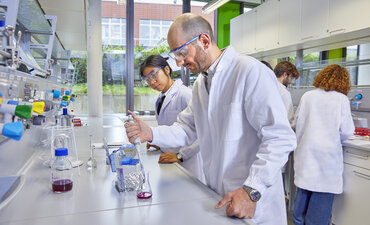
You won’t find traditional lectures or seminars. Instead, we focus on personalized learning paths and support you in building on your strengths and developing new skills. You’ll spend your time both working in teams in our labs—where you can immediately put what you’ve learned in theory into practice—and engaging in self-study to really delve deeply into specific topics.
As your studies progress, the projects will become more complex and challenging. You’ll be able to choose for yourself which specialized skills you want to acquire, allowing you to become either an expert in a specific field or a generalist.
In the sixth semester, you’ll complete an internship or study abroad before concluding your degree in the seventh semester with your bachelor’s thesis and a colloquium.
Not only can you, but you’re actually required to: In the sixth semester of your degree programme, an internship or a semester abroad is mandatory. With our support, you can either find an internship at a suitable company or broaden your academic horizons by spending a semester at one of our partner universities.
On our campus and during your degree, you’ll meet lots of people from all over the world. The language we all share – and the language of your degree programme – is English. Even if you don’t feel confident with another language at first, you’ll find that you’ll quickly get the hang of it and English will become your everyday language. You’ll pick up the specialist terminology as part of your studies anyway.
By the end of your degree, you’ll not only be really good at technical English but also at everyday English. This means you’ll be ideally equipped for jobs in international teams all over the world.
- … you’re interested in a completely different way of studying
- … you can definitely be on campus full-time three days a week
- … you enjoy working in teams
- … you’d rather work in a lab than sit in a lecture
- … you want to become an engineer and keep sustainability in mind throughout your professional career
- … you’re willing to work intensively not only on your technical knowledge but also on your personal skills
A degree programme with a specialized project structure
This programme has a few requirements for you: For example, you must be on campus full-time at least three days a week during the semester so that you can participate in the projects. The remaining two days are set aside for independent study, though field trips are often held on one of those days. Please plan accordingly.
Application process
This degree programme has restricted admission. This means that there are only a limited number of places available. If the number of applications exceeds the number of places available, a selection process will take place. Places are allocated in accordance with the regulations of the federal state of North Rhine-Westphalia.
Following the selection process, you will receive either:
- a letter of admission or
- a letter of rejection.
If you are offered a place, you must enrol at Rhine-Waal University of Applied Sciences within the specified deadline (you will find instructions on how to do this in the letter of admission, which you can download from the university’s application portal). Only then is your place on the course secured.
Admission letters for degree programmes with restricted admission are usually sent out at the beginning of August.
Nummerus Clausus (NC)
For some degree programmes, admission is only possible with a specific (subject) A-level mark (Nummerus Clausus). The NC is set anew each year; figures from previous years serve as a guide.
Waiting list procedure
Sometimes, admitted applicants do not take up their place. In this case, the vacant places are allocated through the waiting list procedure.
This procedure usually begins in late August or early September. If you have applied by the deadline, you will automatically be included in the process.
Lottery
If places are still available after this, a lottery may also take place. The lottery procedure is used to allocate study places that remain available after the regular allocation process has been completed. Interested applicants can register for the lottery procedure via the university’s application portal by 1 September; places are then allocated by random selection from among all valid applications.
First, register on hochschulstart.de. There, you will be given an applicant ID (BID) and an applicant authentication number (BAN).
You can then use these details to apply via Rhine-Waal University of Applied Sciences’ Application portal.
First, register on hochschulstart.de. There, you will be given an applicant ID (BID) and an applicant authentication number (BAN).
You can then use these details to apply via uni-assist.
Impressions


Questions und Contact

Campus
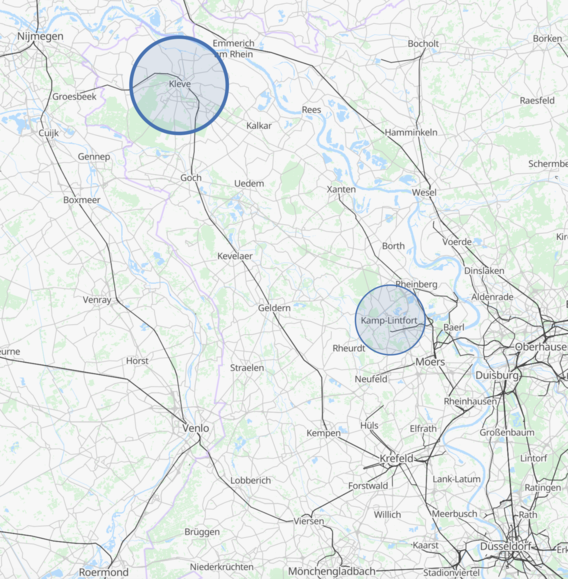
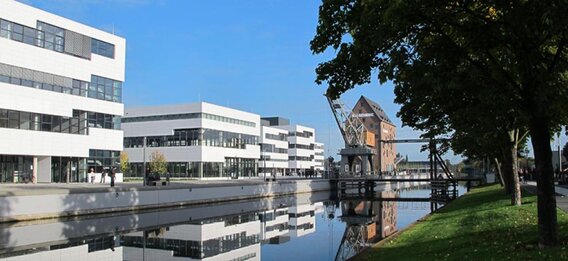
Kleve Campus
Related degree programmes
Student information

All about your studies
Der Prüfungservice ist für dich da, wenn es um folgende Themen geht:
- die abschließende Bearbeitung deiner anerkannten Studien- und Prüfungsleistungen
- die Organisation deiner Prüfungsanmeldungen über HISinONE
- Leistungsbescheinigungen, Urkunden, Abschlusszeugnisse sowie die Beglaubigungen der vorgenannten Dokumente
- die Beantragung deiner Zulassung zur Bachelor- oder Masterarbeit
- die Beantragung deines Praxis- oder Auslandsstudiensemesters
- die Annahme deiner Abschlussarbeit sowie die Weiterleitung an die Prüferinnen und Prüfer
- das Ausstellen von Zweitschriften deiner Zeugnisse und Urkunden
Links und Downloads
Prüfungspläne
Prüfungsordnung
Seite Prüfungsservice inkl. FAQ
Seite Prüfungsausschuss
Die Hochschule Rhein-Waal bietet dir Beratung und Unterstützung rund ums Studium aber auch rund um persönliche Lebensbereiche, z.B.:
- Literaturrecherche
- Gründungen
- psychische Belastung
- Studieren mit Kind
- Studieren mit Behinderung
- Antidiskriminierung etc.
Hier findest du einen Überblick über alle Beratungsangebote
Zusätzlich dazu gibt es Angebote deiner Fakultät zu deinem Studiengang.
Hier findest du einen Überblick über Beratungsangebote deiner Fakultät
Allgemeiner Service
Der Studierendenservice hilft dir bei:
- der Bewerbung sowie Zulassungs- und Auswahlverfahren für Bachelor- und Masterstudiengänge
- Deiner Ein- und Ausschreibung (Immatrikulation und Exmatrikulation)
- der Rückmeldung, Beurlaubung oder Mobilitätsbefreiung
- Anliegen rund um Gasthörerschaft, Zweithörerschaft oder ein Jungstudium
- einem Studiengangswechsel oder dem Einstieg in ein höheres Fachsemester
- der Ausstellung offizieller Dokumente, wie z. B. Studienbescheinigungen
- allen Fragen zu Semesterbeiträgen und Zahlungen
- Meldungen an die Krankenkassen gemäß den gesetzlichen Vorgaben
Im curricularen 6. Semester machst du entweder ein Praktikum oder gehst an eine Partnerhochschule ins Ausland.
Für das Praktikum wendest du dich am besten an eine*r deiner Professor*innen.
Für das Auslandssemester findest du alle wichtigen Informationen hier.
Bibliothek
Hochschulsport
Hochschulmusik
Sprachkurse