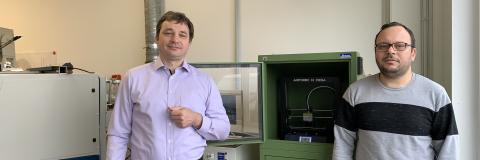
Rhein-Waal University of Applied Sciences has now addressed the shortage of face masks for the second time. Together with alumnus Sadok ben Salem, who is responsible for prototype construction at Polyoptics GmbH in Kleve, Professor Dr Georg Bastian, Professor of Applied Optoelectronics and Laser Physics, developed a respirator mask from a diving mask. To achieve this, a filter was fitted via an adapter in place of the snorkel. A prototype was produced using a 3D printer.
Various stakeholders were contacted to facilitate production and to test the mask’s suitability for use. The respirator was initially tested at St Antonius Hospital in Kleve. This provided valuable insights for further improvements. “We are very impressed by the university team’s commitment and support the development of a practical alternative to conventional face masks,” said Andreas Derksen, Medical Director of the Central A&E; Department at St Antonius Hospital in Kleve, and Tim Wieggers, Head of the Intensive Care Unit / Intermediate Care at St Antonius Hospital in Kleve. “The system seems very promising to us, and the collaboration with the university is very productive and straightforward.”
The companies TROX from Neukirchen-Vluyn, GIZEH from Gummersbach and Intersurgical from Sankt Augustin were brought on board due to their expertise in the field of filter and respiratory technology. There was also very close consultation with experts from the Kleve District Health Authority, the German Red Cross (DRK) Disaster Relief Service and the Ministry of Health in Düsseldorf. The Kleve-based diving shop Sport Köppel is responsible for supplying the diving masks. “It is remarkable how quickly, easily and constructively all our discussion partners responded to our proposal. This enabled us to implement several improvements in a very short space of time and to submit an urgent application for approval as a medical device to the relevant Federal Institute for Drugs and Medical Devices,” explains Professor Bastian.
An adapter for various filter types, which is currently still being produced using 3D printing, is to be manufactured using injection moulding in future. Various filter variants can be selected: the FFP3/N95 filter, used in standard high-quality face masks, filters out
95 per cent of particles. The so-called HME filter, which is generally used in ventilators, filters out 99.9999 per cent of particles. Filters designed for lung function tests provide 99.99 per cent filtration. The ‘converted diving mask’ thus offers significantly better protection than standard masks. In view of the expected shortage of HME filters, Professor Bastian’s team has developed a further filtering technique. A special adapter can be fitted with screw-in cigarette filters. At 0.2 µm, cigarette filters have a much smaller pore size than FFP3 filters (0.6 µm) and are available in large quantities worldwide.
“This example also demonstrates how well Rhein-Waal University of Applied Sciences is networked within the region and beyond, and how, as a university of applied sciences, it not only lives up to the principle of knowledge transfer but also collaboratively puts its expertise at the service of the greater good during the current crisis,” emphasises President Dr Oliver Locker-Grütjen.
As similar developments involving diving masks from various manufacturers are taking place in parallel, Rhein-Waal University of Applied Sciences has now established links with them. It is still seeking industrial partners for the high-volume injection-moulding production of the adapters. Medical institutions (not private individuals) can already order masks with suitable adapters from Sport Köppel for their own testing, even before official approval has been granted. The masks are already being tested in hospitals in Wesel, Emmerich, Goch, Kevelaer and Geldern. The next steps for the Rhine-Waal University of Applied Sciences are aimed at disseminating the technology both within and outside Germany.
For enquiries and suggestions, please contact maske@hochschule-rhein-waal.de.