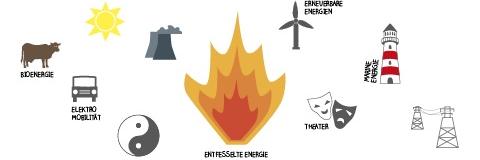
Energy drives everything – not only people and machines in a physical sense, but also public sentiment in politics and society. This semester, the Studium Generale programme at Rhine-Waal University of Applied Sciences is therefore dedicated to the theme of ‘energy’ in its various forms and meanings. Dr Alexander Struck, Professor of Theoretical Physics, and Alexander Gerber, Professor of Science Communication, will open the lecture series on 17 October 2017 at 7.00 pm with a talk entitled ‘Energy from a natural science and social science perspective’.
Dr Heide Naderer, President of the University, and Prof. Dr Jens Gebauer, Vice-President for Research and Knowledge Transfer, are looking forward to welcoming a large number of interested visitors on the evening. “We invite everyone, whatever their age, to attend these fascinating lectures,” says Dr Heide Naderer. The event will take place on the Kleve campus of Rhine-Waal University of Applied Sciences, Marie-Curie-Straße 1, Lecture Theatre Centre, ground floor, Room 01 EG 005 (Lecture Theatre 1).
The opening session, ‘Energy from a Natural and Social Sciences Perspective’, sets the scene for the subsequent talks. It will explain, on the one hand, principles and concepts from physics and, on the other, the socio-political dimension of technologies and innovations in the energy sector. Thus, the expansion of renewable energy is only at first glance a primarily technical challenge – for instance, with regard to energy storage during periods of low wind or sunshine, or the most efficient possible transmission of electrical energy over hundreds of kilometres. For when overhead power lines are blocked by citizens’ initiatives, or the end of a long-standing subsidy scheme for photovoltaics brings an entire industry to its knees, the issue is not one of technology, but of social acceptance and political regulation – factors which then have a direct impact on every individual citizen’s electricity bill. What role does the scientific community play in these decision-making processes? How can the needs and attitudes of civil society be anticipated more credibly? How can local energy issues, such as petrol consumption by cars, be more effectively linked to global energy issues, such as climate change, and what role does our information and media environment play in this? The two speakers will make a case for more interdisciplinary perspectives that link the natural and engineering sciences, on the one hand, with the social sciences and humanities, on the other, so that science can make a more effective contribution to the major and minor energy issues of the future.
The lecture forms part of the Studium Generale programme and has been designed to make science accessible to a wider audience through clearly explained talks. The lecture programme is aimed at members of the public, students, school pupils and anyone in the region with an interest in science, as well as lecturers and staff at Rhein-Waal University of Applied Sciences, with a commitment to general, universal education. The lecture series also provides a platform for lively exchange and discussion on current issues. Attendance at the Studium Generale lectures at Rhine-Waal University of Applied Sciences is free of charge and no prior registration is required. Further information on the Studium Generale is available online at www.hochschule-rhein-waal.de/de/veranstaltungen/studium-generale.