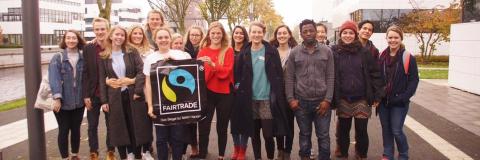
As well as introducing or expanding the range of Fairtrade products in the university’s catering services, the university’s commitment focuses in particular on campaigns and events relating to Fairtrade. The Fairtrade Student Group at Rhine-Waal University of Applied Sciences is responsible for designing, organising and running workshops, discussions and other activities centred on the theme of Fairtrade at the university. In total, around 30 students are involved across both campuses.
One of the highlights of the past Fairtrade event year was the panel discussion ‘How fair is Fairtrade?’, held as part of the Open Day in June 2018 at the Kleve campus. University staff and external academics discussed the pros and cons of Fairtrade with representatives from business and politics, as well as Fairtrade stakeholders. Around 60 visitors attended to listen to the presentations, follow the discussion and actively take part in the exchange by asking questions. The batik workshop, in which cotton clothing and bags are given a colourful makeover, has now also become a well-established event format organised by the Fairtrade Student Group. This textile-dyeing event took place for the third time as part of various university events. However, activities over the past year and a half have also included, amongst other things, repeated participation in the global ‘Fashion Revolution Week’ – which draws attention to unfair working conditions in the textile and fashion industries – as well as the organisation of a student excursion, various information stands and a student swap meet for everyday items on campus, which focuses on the concept of sustainability.
With the Festival of Tolerance on 16 May 2019 in Kamp-Lintfort and the Festival of Sustainability on 17 May 2019 in Kleve, two further events involving the student group are just round the corner. In Kamp-Lintfort, the group will be represented by an information stand and will also contribute to the programme with another batik workshop. At the Festival of Sustainability the following day in Kleve, the student group, in collaboration with the AStA, will offer various workshops on the topics of Fairtrade and sustainability. Alongside creative upcycling ideas and meditation sessions, fair-trade snacks will be available and instructions on how to make beeswax wraps will be provided. A panel discussion on the topic ‘Sustainable Value Chain Act – How would it affect the German economy?’, featuring, amongst others, Martin Schüller (Development Policy, Standards & MEL Officer at Fairtrade Germany), is also on the programme. The aim of both events is to raise awareness of fair trade amongst students and interested visitors alike, to provide information on fair production practices and wages, and to foster an awareness of fair trade products on both campuses.
“Through campaigns on campus and at regional events, these dedicated students are raising awareness of the concept of fair trade at the university and amongst the wider public. We are delighted that, thanks to this commitment, more students and members of the public are becoming aware of how our consumer goods are produced,” said Professor Irmgard Buder – a professor specialising in renewable energy and electromobility at the Faculty of Communication and Environment, and an active member of the university-wide Fairtrade steering group, which comprises representatives from the university administration, the Student Services Organisation and the General Students’ Committee (AStA).
More detailed information on the activities of the Fairtrade Student Group can be found here: www.hochschule-rhein-waal.de/fairtrade
About Fairtrade Universities
Since 2014, higher education institutions in Germany have been able to apply to Fairtrade Germany for the title of Fairtrade University in recognition of their commitment to fair trade. The campaign promotes awareness of fair trade on campus, combined with the practical implementation of activities. To be awarded the Fairtrade University designation, a higher education institution must demonstrably fulfil five criteria relating to its commitment to fair trade at various levels. Across Germany, 26 higher education institutions currently hold this title. Further information on certification and the application criteria can be found at www.fairtrade-universities.de