On
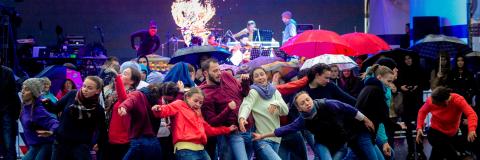
10 September 2017, a very special dance project captivated visitors to the celebrations marking the redevelopment of the riverside promenade along the River Kama in the Russian cultural metropolis of Perm, in the Urals. Max Bilitza, a stage director and theatre producer from Duisburg, staged a performance in Duisburg’s twin town that combined the chamber music of the Et Arsis Piano Quartet with contemporary dance and high-tech 3D video art. Hundreds of spectators were thrilled by this multimedia art project, in which the ‘Media Computing Group’ at Rhine-Waal University of Applied Sciences also played a key role.
Members of the ‘Media Computing Group’ (led by Prof. Ido Iurgel) had travelled specifically to Perm (Russia) to take part in a 10-day workshop at Perm University, where they exchanged ideas with artists from Duisburg and Perm and jointly developed the innovative ‘motion capture’ dance project. ‘Motion capture’ – literally ‘movement capture’ – refers to a process by which human movements can be converted into a format that computers can read. The data is analysed, processed and subsequently used to control graphics, video projections and other applications. The final creative interpretation of the data was developed by Doaa Darwish and Christian Spieß, two students on the ‘Digital Media’ degree programme at Rhein-Waal University of Applied Sciences.
The artist Max Bilitza, who has been a regular guest in Perm for more than nine years and has fostered numerous encounters between Russian and European artists, was delighted with the interdisciplinary collaboration with the university. “Motion-capture technology has yet to be fully explored for the theatre stage, but it holds immense potential. I dream of a production in which the stage set, together with the performers, is situated in cyberspace, and the audience sees only the bare, ‘naked’ body of the performer on stage, whilst in the background, on an LED screen, vast, three-dimensional theatrical worlds unfold,” says the Duisburg-based choreographer.
Prof. Ido Aharon Iurgel is also struck by the fact that, despite all the technology, we cannot do without humans as mediators of content; rather, it is precisely the exploration of the human body as a medium of expression and communication that could be rediscovered in the future. “This form of digital visualisation of movement is not primarily about mere visual stimulation; it is about more than just bright colours, superficial effects or clever technical surprises. New forms of expression are being explored and created that expand the expressive capabilities of the human body in dance and theatre and offer new possibilities for understanding and illustrating movement and states of mind,” says the professor from the Faculty of Communication and Environment at Rhine-Waal University of Applied Sciences.
The temporary Duisburg-based artist collective consisted of young creatives and artists with roots in six different countries (Bulgaria, Lithuania, Spain, Thailand, Egypt and Germany). The project was funded by the Fasel Foundation, the Department for Politics, Administration and Representation of the City of Duisburg, and by Dr Alfred Wendel, Artistic Director of the Duisburg Philharmonic Orchestra, who once again skilfully brought together the young musical elite of North Rhine-Westphalia with the independent arts scene.