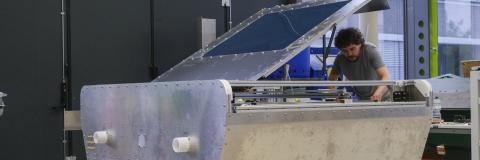
The open-source philosophy is becoming increasingly important: alongside the idea of using software and products free of charge – which can be adapted to one’s own needs and redistributed – open source also stands for the open and free transfer of knowledge. This principle is being applied not only in the software sector but also to hardware products, buildings, vehicles and machinery, amongst other things. At the FabLab at Rhein-Waal University of Applied Sciences in Kamp-Lintfort, Daniele Ingrassia and Ahmed Abdellatif have now developed a unique open-source laser cutter.
The “LaserDuo” laser cutter features two light sources and enables work with a wide variety of materials and large objects. Housed within a robust aluminium casing are a 130-watt CO₂ glass laser and a 75-watt YAG crystal laser, which is why it can process materials ranging from wood, Plexiglas and leather to steel, copper, aluminium and even marble. The 150 x 100 cm work surface also allows for the production of large prototypes such as furniture, advertising banners, architectural elements, etc. Thanks to its height of 50 cm, it is also possible to process chairs, benches, frames or car parts. During development, great importance was attached to the quality of the materials used, a robust construction and compliance with high safety standards. The design also allows for easy access to the machine in the event of maintenance or repair work.
Since the establishment of the first FabLabs (short for ‘fabrication laboratory’), modern digital production processes – such as 3D printing, laser cutting and CNC milling – have been made accessible to the public. These ‘open workshops’ offer the global user community new opportunities to exchange and disseminate knowledge locally, via the internet or through regional networks. In line with the open-source philosophy, those interested are to be trained to such an extent that they can repair or even replicate the laser cutter they have developed themselves. Daniele Ingrassia has already built another laser at the Hamburg OpenLab with students from Tunisia. Further workshops are planned.
Further information and more detailed technical specifications on the ‘LaserDuo’ can be found at http://laserduo.com/.