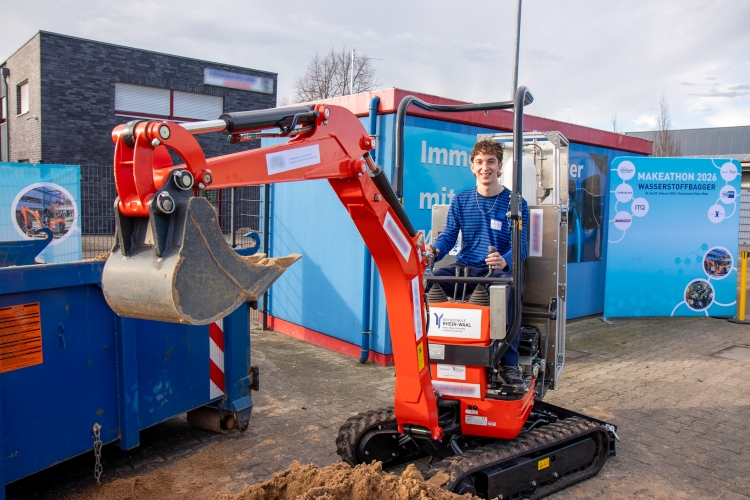
Preparatory work for the Makeathon began as early as the summer term of 2025. Under the guidance of Norbert Reintjes, a technical expert on the HSRW’s TransRegINT project, the trainees dismantled the excavator into its component parts, carried out a data survey and used CAD software to design a basic model. Students from the Faculties of Technology and Bionics, and Communication and Environment then took over: working in small groups under supervision, they planned the conversion in theory. Components were subsequently sourced or fabricated.
During the week of 23 February, six different teams put the theoretical designs into practice – from fitting a new electric motor and overhauling the hydraulic system to upgrading the power supply, including a buffer battery and a hydrogen fuel cell. The first key insight: not everything from theory can be put into practice.
The fact that the excavator ultimately operated with the new motor is of secondary importance to the lecturers involved. They praised the dedicated contribution of the apprentices and students. “Together, they worked towards a common goal; individual strengths and knowledge contributed to the success of the whole group,” said Prof. Dr Irmgard Buder, Professor of Renewable Energies and Electromobility at HSRW. “It is events such as the Makeathon that enable our students to receive a practice-oriented education. It is only when they work and create independently that they develop an understanding of real-world practice, and that is our aim as a university of applied sciences,” added Prof. Dr.-Ing. Peter Kisters, Professor of Mechanical Engineering and Product Design and Vice-President for Research, Innovation and Knowledge Transfer.
The Makeathon is a prime example of successful collaboration with companies from the Lower Rhine region. “In addition to the technical expertise of staff and trainees from the participating companies, our students benefited from the professional working environment at MAKS as well as from the provision of specialised materials, including those supplied by Hexagon Purus,” explains Norbert Reintjes. “In future, we would like to work even more closely with companies in the fields of education and further training. This will enable us to respond more effectively to new demands in technical development and put new ideas into practice more quickly.” Companies wishing to play an active role in the engineering education programme at the Faculty of Technology and Bionics in Kleve can contact Norbert Reintjes directly.
The hydrogen-powered excavator will now serve as a teaching platform for further projects within the engineering programmes at HSRW in Kleve, providing future engineers with practical learning experiences. The topic of hydrogen and other options for CO₂-neutral or low-carbon transport is also being explored at the Kamp-Lintfort campus.
The Makeathon and the ‘Hydrogen Excavator’ project were made possible thanks to the following partners: ITQ GmbH, Omexom, Hexagon Purus, the Lower Rhine Chamber of Industry and Commerce (IHK Niederrhein), the Friends of Rhein-Waal University of Applied Sciences, and MAKS GmbH. Academic supervision on behalf of HSRW was provided by Prof. Dr Irmgard Buder, Professor of Renewable Energies and Electromobility; Prof. Dr-Ing Peter Kisters, Professor of Mechanical Engineering and Product Design and Vice-President for Research, Innovation and Knowledge Transfer; Thomas Klimeck, Transformation Manager for Renewable Energy; Norbert Reintjes, Technical Staff Member at the ‘Transfer-Oriented Faculty of the Future’; and Dipl.-Ing. Daniel Neubauer, Lecturer at HSRW.
Background
Hydrogen, solar energy, wind power and geothermal energy offer an alternative to fossil fuels. The aim of the ‘Renewable Energies’ transformation project within the TransRegINT project is to provide a platform for this diverse range of alternatives, connecting producers and consumers. With the ‘TransRegINT – Transformation of the Lower Rhine Region: Innovation, Sustainability, Participation’, Rhein-Waal University of Applied Sciences has set itself the goal of helping to shape sustainable change in the region on a science-based foundation. The project is funded by the ‘Innovative University’ programme of the Federal Ministry of Research, Technology and Space.