Every year, more than 350,000 people in Europe suffer a cardiac arrest. Fewer than ten per cent survive. That equates to 1,000 deaths a day. A large proportion of them could still be alive if they had been resuscitated in time. However, fewer than 30 per cent of bystanders actually take action in such an emergency situation. There are many reasons for this: a lack of knowledge, fear of doing something wrong, or even a psychological barrier. Immediate assistance is crucial, however, because brain cells die irreversibly after approximately three minutes of cardiac arrest. Despite Germany’s effective emergency services system, it is often still not possible for paramedics to reach the patient within this timeframe. Direct CPR by members of the public can therefore be life-saving.
To raise public awareness of the importance of CPR, students developed a series of ideas as part of the ‘Save Lives’ semester project within the Information and Communication Design degree programme, under the supervision of Susanne Coenen and Nicole Slink, lecturers in Communication Design at Rhein-Waal University of Applied Sciences. By raising awareness, providing information, explaining the process and highlighting what each individual can achieve, they aim to encourage people to respond appropriately in the event of a cardiac arrest.
The project was carried out as a student competition in collaboration with the start-up company Corevas GmbH & Co. KG from Grevenbroich. For the past three years, Corevas has been developing the product and process innovation EmergencyEye®, a smart digital technology designed to locate someone in need of help and establish a direct video link via smartphone to the scene of an incident, thereby enabling better communication and, consequently, faster assistance.
A total of 15 students took part in the competition. Twelve designs were submitted. An eight-member jury – comprising the EmergencyEye team led by Professor Dr Günter Huhle, Carola Petri, Managing Director of Corevas, and Stephanie Marniok, Art Director at the agency Lockstoff Design GmbH, also based in Grevenbroich – assessed the various campaign ideas and ultimately selected three winners.
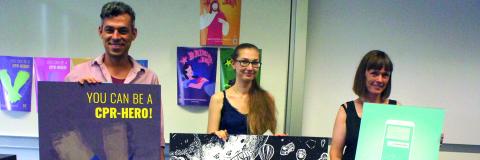
João Heleno Duarte, a student from Brazil, has taken first place, which comes with a prize of 1,000 euros. Jana Uhlig, a student from Krefeld, receives 500 euros for her second place. Third place, and with it 300 euros, goes to Maria Willsch, a student from Moers.
The winning designs
João Heleno Duarte’s design features a colourful and fresh campaign entitled ‘YOU CAN BE A CPR Hero’. It aims to encourage people to be heroes and to act appropriately in an emergency. Drawing inspiration from superheroes from the world of film, such as Batman or Spider-Man, their hands strike the typical CPR pose on the colourful posters.
Jana Uhlig innovatively illustrates the dreams that can be lost if resuscitation is not performed. Brought to life through ‘chest compressions’ on interactive posters, the dreams of a wide variety of people appear, made possible once again through resuscitation. The app can also be used on smartphones.
Everyday life inspired Marie Willsch in her ‘Hands can save lives’ campaign. On her posters, she depicts everyday moments in which we use both our hands – for example, whilst driving or typing a message on a smartphone. In doing so, she conveys to the viewer that it is just as easy to save a life with one’s hands.