Kleve/Kamp-Lintfort, 14 March 2016: Just a few years ago, the large shopping centres and supermarkets on the outskirts of town were seen as the cause of the increasing decline of our town centres. Nowadays, they too are affected by the growing dominance of online retail. More and more customers are choosing the convenience of online shopping over a trip to the town centre or a shopping centre. It is not only small and medium-sized towns that are feeling the effects of this trend; the retail sector in major cities is also coming under increasing pressure.
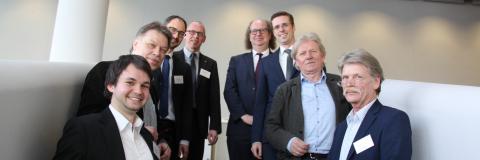
How local authorities can respond to this challenge whilst still attracting customers to their town centres was the subject of the symposium, at which recognised experts in the field presented strategies for solutions and discussed them with representatives from towns and local authorities, as well as from business development agencies. The symposium was organised by the Director of the IKV, Dr Bernd M. Lindenberg. The invitation leaflet states: “Whereas the boot used to be the customer’s largest shopping bag, today it is the shopping basket in the online shop. The car used to drive customers to the large supermarkets on the outskirts of town centres. Today, they have their goods delivered to their homes.”
Prof. Dr Jakob Lempp, Dean of the Faculty of Society and Economics at Rhine-Waal University of Applied Sciences, described the problem in no uncertain terms in his opening address: “With the decline in shopping trips through colourful and bustling city centres, there is a risk of losing much that goes far beyond the mere act of purchasing: letting oneself be carried along by the flow of people, encounters with familiar and unfamiliar faces, the direct tactile experience of products, or even a chat with the local shopkeeper, whom one may have known since one’s youth.”
This was followed by a comprehensive programme of presentations, during which various examples of best practice from the local authorities in Neuss, Düsseldorf, Wuppertal and Krefeld were showcased. Karl Jasper, Senior Ministerial Adviser at the Ministry of Construction, Housing, Urban Development and Transport of the State of North Rhine-Westphalia, for example, addressed in his presentation the role of urban development funding in strengthening city centres. Other proposed solutions focused on the findings of studies into the link between shopping behaviour and quality of life, as well as the approaches taken by various local authorities to provide online platforms for their towns and cities.
However, online retail is not fundamentally superior to high-street retail in all areas, as Prof. Dr. habil. Gregor van der Beek, Professor of Economics specialising in Finance at Rhine-Waal University of Applied Sciences, noted in his presentation: “Online retailers do not always have the better business model, even when they are successful in their markets. For sometimes their success is primarily due to the fact that they manage to pass on costs – which they would actually have to bear themselves – to others, and specifically to local retailers. These include, for example, the costs of providing product information and advising customers.”
The event concluded with a lively panel discussion featuring the speakers, moderated by the Director of the IKV, Prof. Eberhard G. Fehlau.