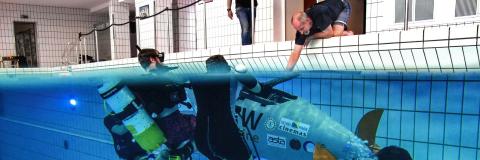
Since the end of last year, the Embricana swimming pool in Emmerich has been hosting training sessions during the winter months. Once a month, students from the Faculty of Technology and Bionics have had the opportunity to test the submarine they designed themselves in the pool’s sports lane outside of normal opening hours. “We are very grateful to have been given the opportunity to train here. This has allowed us to carry out tests and further develop our submarine even during the winter months,” says Professor Megill – Professor of Bionics specialising in sensor technology and robotics – who founded the “HSRW Submarine Team” as a student project in 2012.
At times, two teams were training simultaneously in the indoor swimming pool, which, with a depth of 3.65 metres, offered ideal conditions for practising with the training submarine. This year’s student team was preparing for an important open-water competition on the French Mediterranean coast – where they also came up against their familiar rivals, the team from Delft University of Technology.
And the 2020 team is also starting their training early – next year they will travel to England to take part in the European Submarine Race. As in previous years, they are expected to secure top places in the various categories of the competition. However, the success of the HSRW Submarine Teams is by no means a foregone conclusion. Only if the students work together as a team and continually take on new challenges will they be able to achieve good placings once again. And the rules of the European Submarine Race are strict: to be eligible, the students must design and build the submarine themselves. The submarine’s development must then be documented through reports, photographs and videos. “Only those who submit the documentation on time and have completed construction of their submarine by February/March will be granted permission to compete,” explains Professor Megill.
An important aspect of the student project is the ongoing development of the submarines. The insights gained from the practical sessions are also incorporated into the design of the new submarines. Each team decides on the design itself. Whilst this year’s team focused on developing navigation instruments for open-sea voyages, the 2020 team intends to concentrate on propulsion. The additional thrust is to be achieved by doubling the number of fins (four pairs). Furthermore, the submarine will be built from a new material, in keeping with the spirit of sustainability practised at Rhine-Waal University of Applied Sciences. “We will be using PETG plastic and cork. Thanks to these materials, the submarine will then be fully recyclable,” explains William Megill.