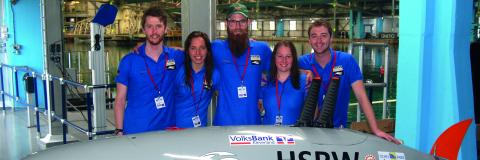
After months of designing, building and training for the European International Submarine Races, students from the Faculty of Technology and Bionics at Rhein-Waal University of Applied Sciences have once again pulled it off, enabling them to take part in this biennial competition for the third time. With their submarine ‘Rivershark II’, the students held their own against a total of twelve teams from Canada, the USA, Poland, the UK and the Netherlands. Although only 7 out of a total of 14 students were able to take part in Gosport, England, this time due to visa difficulties, they still managed to finish in sixth place.
A particularly notable achievement is the additional prize for the best biomimetic submarine, as it is a tribute to the entire “HSRW Submarine Team” in recognition of their meticulous design work, their performance on the race course and the overall reliability of their submarine. “It’s great to see that our hard work is paying off, especially when we’re competing against the world’s best at an international competition like this. The result makes me proud of our team,” said chief engineer and pilot Hannes Jaschinski, delighted with the award.
Pilot Sarah Luckhardt also won the prize for the best female pilot in the competition. Even more impressive, however, is her achievement in taking ‘Rivershark II’ to a new top speed: In the waters off Gosport, she reached just over 2.7 knots (5 km/h) – the fastest speed ever achieved by an “HSRW-Submarine Team”. “A great deal was learnt amidst all the fun the teams had both on and off the course. And, of course, there’s nothing better than a competition that ends with a new speed record,” concluded Professor Dr William Megill, race director at the Institute of Marine Engineering, Science and Technology (IMarEST), co-organiser of the competition and Professor of Bionics at Rhein-Waal University of Applied Sciences.
The competition was characterised by the diversity of the vessels’ designs. Tradition met modernity: for example, carbon-fibre and 3D-printed hulls competed against those with wooden planking or hand-laid fibreglass, innovative bionic propulsion systems challenged highly efficient propellers, and automated mechatronic control systems vied with the traditional joystick. The overall winner at the end of the two-week competition was the Canadian team from the École de technologie supérieure in Montreal with their submarine, Omer 11.