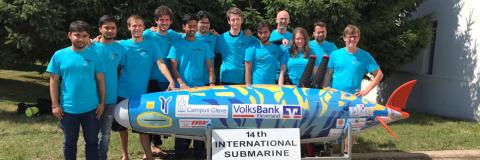
With the Rivershark II submarine, which they designed and built themselves, the students from the Faculty of Technology and Bionics in Kleve held their own against a total of 20 teams from the USA, Canada, Mexico, the UK and the Netherlands. They won a bronze medal for the speed achieved in the propellerless class and another in the ‘Innovation’ category – specifically for the sonar-driven autopilot featuring an artificial lateral line system, in other words, for genuine bionic elements incorporated into the submarine.
These placings are a fine reward for the long hours of work put in by Professor William Megill’s team. Eleven students were able to celebrate the strong results on site, whilst five other crew members kept their fingers crossed from Germany. This was particularly necessary after the submarine collided with a wall, leading to technical problems.
Whilst the HSRW Submarine Team was working energetically on the Rivershark II, tinkering and gluing, the Mexican team had quite different concerns: the Mexican submarine had got ‘stuck’ at customs and nobody knew whether it would be operational within the competition timeframe. During this time, a spirit of mutual solidarity developed between the two teams in distress. The Mexican divers took turns with the exhausted divers from Germany to get the Rivershark II back on track in the cold and murky pool at the US naval base.
Above all, team spirit and the determination not to let the months spent designing the Rivershark II and transporting it all the way to Washington go to waste enabled the students – including submarine pilot Leonie Wesener and pilots Alam Sayied and Tobias Riphaus – to rise to the occasion once again. When, at the end of the competition, the Mexican submarine was finally given the go-ahead, the cross-cultural sporting camaraderie with the Mexican team was put to the test.
The team from Rhein-Waal University of Applied Sciences would have had the chance to secure overall victory in the ‘Speed’ category in a final race, but the remaining competition time allowed for only one more start. It came down to either Germany or Mexico. The HSRW Submarine Team was naturally disappointed but nevertheless accepted the decision: Mexico would compete. Despite all the setbacks, the German team managed to make it onto the podium, and the bronze medal they won is far more than just a prize for speed.
Their placing in the ‘Innovation’ category demonstrates just how well the collaboration between mechanical engineers and bionics specialists had already been working, and, not least, how the equally international team from Rhein-Waal University of Applied Sciences can work together successfully, putting in hard work and heart.
Anyone wishing to read about the exciting days of competition in detail (in English) or watch videos of them can do so on Prof. Megill’s online diary: hsrw.oceantechlab.de