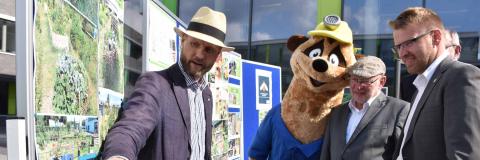
“A ‘wonderful project with many challenges’,” said Professor Jens Gebauer, Vice-President for Research and Knowledge Transfer at Rhein-Waal University of Applied Sciences, summarising the Green FabLab in his welcome address at the fourth Countdown event – a series of events organised by Laga GmbH to help pass the time until the opening in April 2020. The Professor of Sustainable Agricultural Production Systems in Horticulture presented projects on sustainable horticulture and urban gardening to the audience via a poster presentation; these are also set to be featured on the Green FabLab website next year. In addition, various DIY projects were showcased to visitors during the event, including a mini high-tech greenhouse – a so-called ‘grow box’ – as well as a system featuring humidity sensors and a pump for watering houseplants, and DIY seed balls. As well as the construction plans on display, a virtual tour led by Nicolas Fischöder, a research assistant at Rheijnland.Xperiences within the Faculty of Communication and Environment, offered a glimpse of the Green FabLab’s premises.
As a joint venture between the university, the town of Kamp-Lintfort and Landesgartenschau Kamp-Lintfort 2020 GmbH, the world’s second Green FabLab – alongside another in Barcelona – is set to open early next year. Spanning an area of 2,500 square metres, the site will showcase comprehensive experimental and research facilities focusing on water management, hydraulic engineering, renewable energies and urban agriculture. These will be complemented by a permanent ‘biodiversity observation area’ and an exhibition space covering a wide range of topics. The aim of the Green FabLab’s work is to “develop perspectives for our shared future” in “harmony with the natural foundations of life”, according to Professor Kai Jörg Tiedemann, Professor of Ecology and the Environment at Rhine-Waal University of Applied Sciences. Adopting a participatory approach, these ideas will be developed in future through collaborative exchange within the ‘green’ FabLab. The laboratory, which covers around 400 square metres, will offer researchers, school pupils, university students and the interested public digital workshops and technologies to discuss issues relating to the environment and resource efficiency, and to develop proposed solutions for ecological sustainability. With this in mind, Rhine-Waal University of Applied Sciences also aims to create a forum to strengthen collaboration with local businesses and thus jointly maintain the region’s capacity for innovation. During the State Garden Show, running from 17 April to 11 October 2020, the university will offer workshops, seminars and open lectures at the Green FabLab, inviting interested visitors to get actively and creatively involved in experimental areas and project workshops. Other areas of focus at the Green FabLab include ‘Green Architecture and Urban Development’, Green Technology, Green Energy, Green Mobility and Green Landscape.
Further information is available at www.hochschule-rhein-waal.de/laga2020
About the Green FabLab
The Green FabLab is based on the concept of the Fabrication Laboratory – a high-tech workshop equipped with various computer-controlled machines such as 3D printers, laser cutters and CNC milling machines. In such a workshop, anyone can learn to use these machines themselves to make things and try out their own ideas. It is a place for independent experimentation, development, tinkering and production, and for sharing experiences and knowledge with others. At the Green FabLab, the focus is on the environment and its sustainable use – combined with digital manufacturing, this opens up entirely new possibilities for the production of ‘green’ products and processes. All activities are geared towards operating as sustainably as possible: conserving resources, using renewable raw materials, making optimal use of renewable energy, and reducing or even avoiding environmental impacts such as emissions.