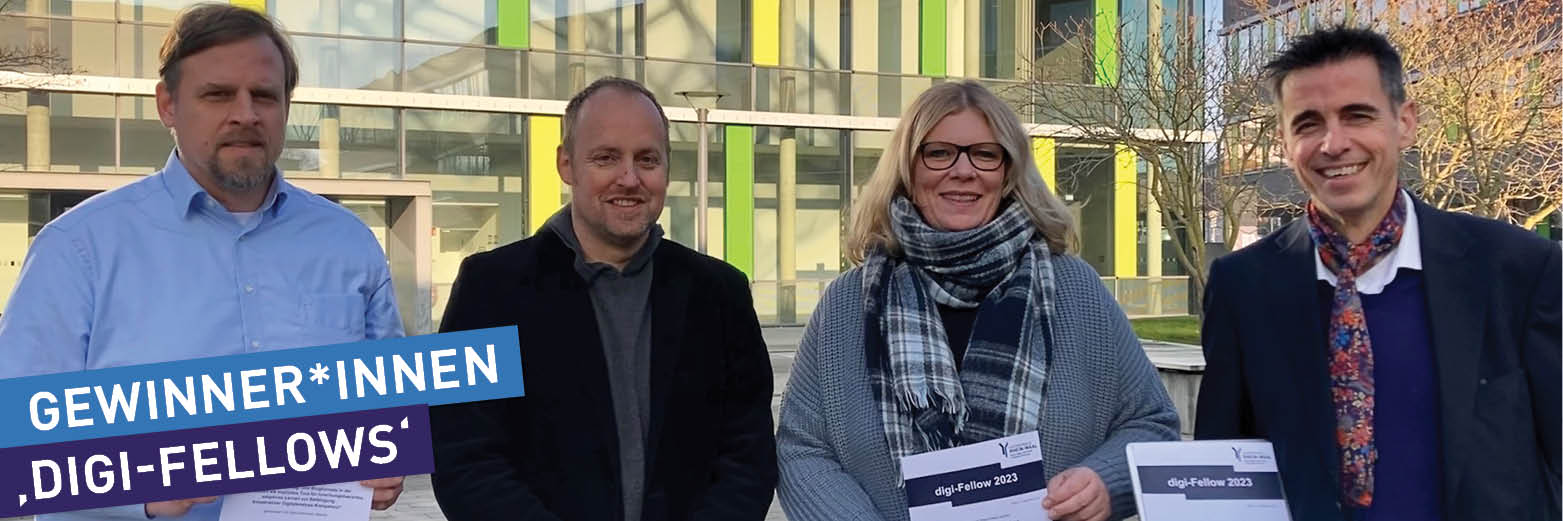
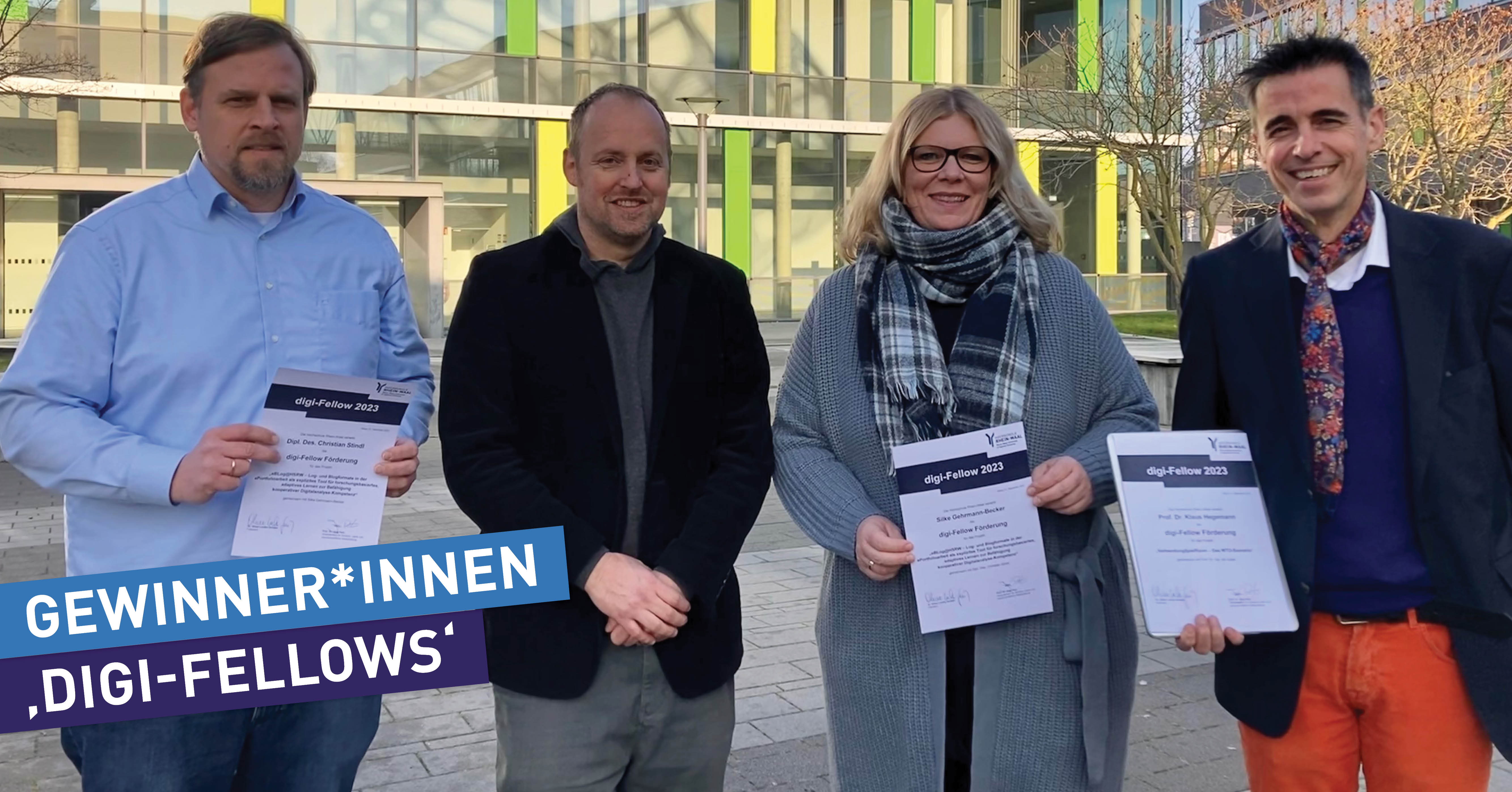
On the one hand, the funding was awarded to the project ‘VerhandlungSpielRaum – The WTO Scenario’ by Prof. Dr Klaus Hegemann and Prof. Dr Ido Iurgel, and, secondly, to the project ‘eBLog@HSRW – Log and blog formats in e-portfolio work as an explicit tool for research-based, adaptive learning to foster collaborative digital analysis skills’ by Christian Stindl, representative of the media production professors, and Dipl. Des. (FH) Silke Gehrmann-Becker – all from the Faculty of Communication and Environment at the Kamp-Lintfort campus.
Through ‘VerhandlungSpielRaum – The WTO Scenario’, regular digital role-playing games are organised as part of a World Trade Organisation conference within the Bachelor’s degree programme in International Business Administration. Working in small groups, students take on the roles of national delegations, international organisations and interest groups. Through this, students learn to reach overarching agreements that both serve the individual interests of states and organisations and create global spaces for their realisation. The roll-out of the role-play concept will take place in close collaboration with SpielRaum TrainingBeratungEntwicklung, a company based in Mühlheim an der Ruhr that specialises in the development of educational games.
The project ‘eBLog@HSRW – Log and blog formats in e-portfolio work as an explicit tool for research-based, adaptive learning to foster cooperative digital analysis skills’ builds on the current ‘Digital Transformation diGATE’ project. Funding from the ‘digi-Fellow’ scheme will enable the transition from the pilot phase to the practical implementation of the Mahara e-portfolio software in the summer semester of 2023 within the Bachelor’s degree programme in Information and Communication Design. Mahara offers students an e-learning platform that can be customised in terms of both content and form, on which they can document, evaluate and publish their learning objectives based on the teaching modules provided by lecturers. This new form of teaching and learning is supported by video tutorials that have been specifically designed and produced for this project. Interested lecturers will likely be able to exchange ideas and share examples of best practice via a sample e-blog from April/May 2023 onwards.
This year’s jury members were:
Prof. Dr Miriam Barnat, Aachen
University of Applied Sciences; Prof. Dr Peter Hartel, Bielefeld
University of Applied Sciences; Ms Annamaria Köster, Ruhr West
University of Applied Sciences; Prof. Dr Franca Ruhwedel, Rhine-Waal
University of Applied Sciences; Prof. Dr Joachim Fensterle, Rhine-Waal University of Applied Sciences
About the ‘digi-Fellows’ programme Funded by the Ministry of Culture and Science of North Rhine-Westphalia since 2016,
the initiative was implemented in cooperation with the Stifterverband until 2019 and incorporated into the digitisation agreement in 2020. Since then, all eligible universities in North Rhine-Westphalia have received 50,000 euros annually to fund a project led by one or more academic staff members. To award the fellowships, the universities hold an institution-wide competition each year. A meeting of the fellows takes place every semester to facilitate exchange and networking. In addition, teaching innovations are presented at a public, annual teaching and learning conference.