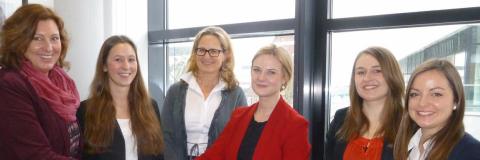
Kleve/Kamp-Lintfort, 3 March 2015: As part of the practical workshop held annually during the winter term, students on the ‘Alternative Tourism’ degree programme worked on current projects for tourism clients from the region. Under the overarching theme of ‘Catering, Accommodation and Events in the Lower Rhine Region’, companies from various sectors in the Lower Rhine region were invited to submit project proposals. The requirements were very varied, ranging from needs or market analyses, through the creation of marketing and event concepts, to the development of (cycling) and walking holiday packages. At the start of the term, the students were able to choose from these projects and carried out analyses over a period of around three months. They learnt how to liaise with a client, organise themselves independently within a team and work on projects. At the final presentation in January, the students showcased work that was technically superb and creative.
As part of the project, the Alter Bahnhof Tourist Information Centre in the municipality of Kranenburg received support, amongst other things, in developing a series of events called ‘Kriminales Kranenburg’. This also resulted in a one-day culinary cycle tour through the border region around Kranenburg, including booking documents, leaflets and a promotional video. A creative marketing concept was developed for Count Friedrich zu Eulenburg’s new ‘UHU Lodge’ in Weeze, and Niederrhein Airport was provided with a programme of events and entertainment at the terminal. The Hotel Klostergarten Kevelaer and Kleve Marketing GmbH placed further emphasis on assessments of accessible tourism in their respective towns. This is a topic that is not only gaining importance in today’s society but is also one that students are increasingly engaging with. Inclusion is a key component of the Alternative Tourism degree programme’s curriculum. Kleve Marketing GmbH, which was a project partner for the third time, will publish the newly gathered information on its own website in future. “We are very grateful for the students’ academic work, which would simply be beyond the means of our staff in their day-to-day operations. It enables us to offer an additional service to our guests,” says Ms Schulze-Heiming of Kleve Marketing GmbH. Jochen Arden, owner of Zelem Castle, was presented with a concept for opening a ‘castle garage’ showcasing exclusive classic cars. And Count zu Eulenburg of Hertefeld Castle in Weeze received a proposal to brew his own castle beer – an idea he is certainly considering.