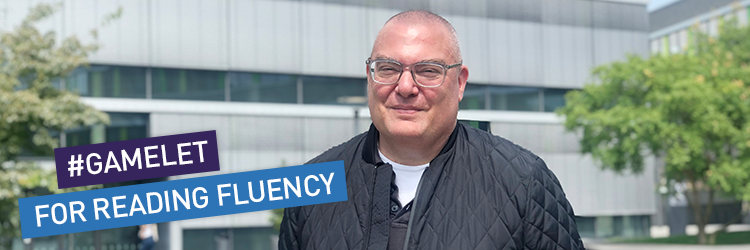
‘GameLet’ is based on the approach known as ‘multilingual reading theatre’, a method for promoting reading fluency in different languages. In reading theatre, pupils read texts aloud and prepare for them as they would for a theatre performance (see Kutzelmann et al., 2017). ‘GameLet’ develops concepts and software for a digital reading theatre: with the help of the ‘GameLet’ software, pupils are guided through a series of tasks (missions) that are enriched by various educational games. This approach particularly encourages playful, engaging learning. The ‘GameLet’ methods can be used for both the mother tongue and foreign languages. One of the motivations behind the project is that reading fluency is the crucial skill underpinning reading comprehension (NICHD, 2000), which in turn is key to good performance in other subjects (Grabe & Stoller, 2011). However, the partner countries show deficits in reading proficiency and multilingualism – particularly at lower secondary level (OECD, 2019). In response to these challenges, ‘GameLet’ provides teachers with a structured, pedagogically sound approach and a range of corresponding software tools to promote pupils’ reading fluency in a motivating way. At various levels, ‘GameLet’ transforms the development of reading skills into a playful activity in which pupils can experiment and develop together, whilst also enhancing their media literacy.
At the heart of ‘GameLet’ is the collaborative recording of a podcast, written in various languages, which is designed to encourage learners to read their role texts repeatedly. ‘GameLet’ enables learners to record their part in a digital recording studio, both in class and at home. The system supports this task in a wide variety of ways, whether through specific feedback mechanisms, tools for annotating texts in preparation, specialised games focusing on reading intonation, and much more. The aim is to improve reading fluency through media-supported individual and collaborative learning phases, utilising various reading training methods, playful learning scenarios and materials, and interactive elements.
Between May and July 2021, four multiplier events were held in Germany, Portugal and Cyprus, at which the preliminary results were presented primarily to teachers and trainee teachers. The reactions were extremely positive and very encouraging. Many of the teachers asked when ‘GameLet’ would be made available to schools – they would like to start using it as soon as possible. An exact date could not yet be given, as the project is not developing commercial software. However, the project partners are currently working on a solution to ensure that the results can be widely implemented as soon as possible.
In ‘GameLet’, Rhein-Waal University of Applied Sciences is developing the core software and is collaborating with other partners on the basic and game concepts. Project participants include Weingarten University of Education (Germany), the University of Minho (Portugal), the Open University of Cyprus (Cyprus), the Cypriot Ministry of Education and Culture, and partner schools.
Participants from Rhein-Waal University of Applied Sciences include: Prof. Dr.-Ing. Ido Iurgel (Media Informatics), Anabela Parente (project assistant, software development), Dr Digdem Sezen (visiting researcher), Johannes Franzen (Media Informatics student), Mohamed-Rami Mezghani (Communication and Information Engineering student), and others.
Further information
www.gamelet.eu
Contact
: Prof. Dr Ido Iurgel
Faculty of Communication and Environment
Professor of Media Informatics
Telephone: 02842 90825 286
Email: ido.iurgel@hochschule-rhein-waal.de