Under the title ‘Holiday Explorations’, the local press publishes a weekly ‘House of Little Scientists tip’ for parents and children on exploring everyday phenomena. On the topic of water, the series explores, amongst other things, the chemical and physical properties of H₂O. But biology isn’t neglected either: to kick things off, parents and children were invited to explore the aquatic life at the Sieben Quellen in Nütterden near Kleve.
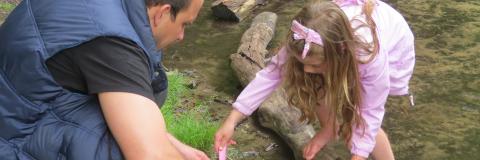
Armed with landing nets, sieves and tins, children and parents caught a fascinating variety of aquatic creatures from the spring area and identified the different species using illustrated charts. Targeted questions sparked further exploration. For example, with the help of large standing magnifying glasses, the young researchers were able to observe more closely the unusual way the diving beetle and the water scorpion move, as well as the water scorpion’s impressive mouthparts.
Both children and adults were fascinated by the silvery, shimmering air sac of the diving beetle – which, despite being an aquatic creature, breathes atmospheric air – and by the ‘walking stick’, which turned out to be a self-built and inhabited case made by a caddisfly larva. Under the expert guidance of biologist and nature education specialist Barbara Maué, the participants discovered what materials the larva uses to build its case. Thanks to an illustration they had brought along, they were then able to visualise what the adult insect looks like.
To provide an opportunity to identify stream creatures during the remaining weeks of the research holidays, identification boards were installed at the Sieben Quellen bridge by the ‘Haus der kleinen Forscher’ in the Kleve district, in consultation with the forestry authority. Further information on the other holiday research activities, as well as the tips themselves, can be found here.