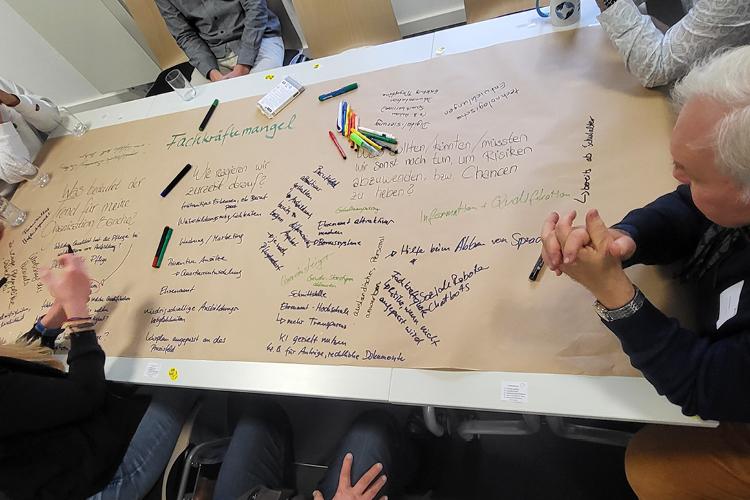
Around 40 representatives from care homes, towns and local authorities, as well as from district administrations and the business sector, gathered at the Rhein-Waal University of Applied Sciences campus in Kamp-Lintfort at the end of October to tackle this challenge together. In her keynote speech, Prof. Dr Nele Wild-Wall made it clear why a joint strategic process is urgently needed: the district of Wesel is already one of the ‘oldest’ districts in North Rhine-Westphalia, with the highest number of older people, whilst at the same time having a below-average density of care services. Added to this is the fact that social and economic conditions are changing rapidly: skills shortages, demographic change, urbanisation, changing family structures and technological developments are increasingly calling current care provision processes into question.
Prof. Dr Christian Ressel, the initiator of the workshop series, sees it as an important platform for a joint new beginning: “The high level of participation has shown that there is a genuine need to think strategically about the future of care provision in the region. The high level of interest in technical support options, including in the field of AI, was particularly encouraging. I expect that in the upcoming modules we will be able to welcome further technology-focused providers who will actively contribute their solutions to our shared vision.”
At the launch event, social care organisations, care homes and local authorities were particularly well represented. The workshop series has a clear objective: to work together with regional stakeholders from business, civil society, public administration and politics to develop a viable vision for 2035, identify concrete first steps towards its implementation, and thereby evaluate the strategic direction of their own organisations. The focus is on developing a vision statement designed to have an impact both externally and internally.
Externally, it serves to facilitate communication and coordination with decision-makers at all levels, including politicians, public administration and the general public. Internally, it provides guidance for investment, forms the basis for the strategic direction of companies, institutions and local authorities, and serves as a reference point for regional innovation processes and research activities.
Upcoming workshops:
The next workshop, taking place on 4 February 2026, will focus on the regional landscape of services: Which provision structures and stakeholders are already active today? What untapped potential exists, and which gaps need to be addressed urgently? Building on this, the subsequent modules will incorporate societal trends and sector-specific developments to create a realistic and forward-looking overall picture. Only then will technological innovations be specifically integrated. The care sector, in particular, has already shown clear interest in the first workshop: there is keen anticipation as to which solutions companies from the region currently have in the pipeline or already on their roadmap.
Invitations and registration will be available from November 2025 via the website https://www.zat.nrw. Remember: your perspective matters – help shape the future.
Background information
The Rhine-Ruhr Centre for Assistive Technologies (ZAT) is a collaboration between Rhein-Waal University of Applied Sciences, Niederrhein University of Applied Sciences, Bonn-Rhein-Sieg University of Applied Sciences and the University of Duisburg-Essen, aimed at further developing assistance and support services for people with disabilities. Since November 2023, this project – supported by the Ministry of Culture and Science of the State of North Rhine-Westphalia – has been building a network of service providers, manufacturers, researchers, associations and people with disabilities. Together, they are developing new process innovations and solutions using digital technologies and putting them into practice. ZAT Rhein-Ruhr serves as a central point of access to issues relating to assistance and participation in the region.
The project website, www.zat.nrw, provides regular updates on the project’s progress and invites visitors to attend current public events.